If you counted one number per second without stopping, it would take about 31.7 years to count to one billion. In real life, counting aloud would take longer because large numbers take more than one second to say, and a person needs sleep, food, and breaks.
Counting One Number Per Second Without Stopping
To understand the sheer scale of a billion, let's start with a theoretical scenario: counting one number per second, continuously, without any pauses. This simplified calculation provides a baseline for how long such a task would take.
- 1 billion seconds = 1,000,000,000 seconds
- Converting seconds to minutes: 1,000,000,000 ÷ 60 = 16,666,666.67 minutes
- Converting minutes to hours: 16,666,666.67 ÷ 60 = 277,777.78 hours
- Converting hours to days: 277,777.78 ÷ 24 = 11,574.07 days
- Converting days to years (using 365.25 days per year for accuracy): 11,574.07 ÷ 365.25 = approximately 31.69 years.
So, under the assumption of perfect, continuous counting, you would be counting for over three decades.
What Changes If You Count Only 8 Hours Per Day?
In reality, no one can count for 24 hours a day. People need to sleep, eat, and take breaks. Let's consider a more "human" schedule of counting for 8 hours per day, which is a typical workday length.
If you count for 8 hours out of every 24 hours, you are counting for one-third of the time. This means the total time required would be three times longer than counting continuously.
- Total time (continuous): 31.69 years
- Adjusted for 8 hours per day: 31.69 years × 3 = approximately 95.07 years.
Counting for 8 hours a day, it would take about 95.1 years to reach one billion. This calculation highlights that even with a consistent pace, such a task would likely exceed a typical human lifespan.
Why Real Spoken Counting Would Take Much Longer
The calculations above are based on counting "one number per second." This works well for single-digit numbers like "one," "two," or "three." However, as numbers get larger, they take more time to say.
- "One hundred" takes longer than "one."
- "One thousand two hundred thirty-four" takes several seconds.
- A number like "nine hundred ninety-nine million nine hundred ninety-nine thousand nine hundred ninety-nine" requires many words and would take several seconds, perhaps even more, to articulate clearly.
Considering the increasing length of number words, the actual time it would take a human to speak every number from one to a billion would be significantly longer than the theoretical one-number-per-second estimates. The time needed to verbalize larger numbers would slow the overall counting rate considerably.
Million vs. Billion vs. Trillion: Understanding the Scale
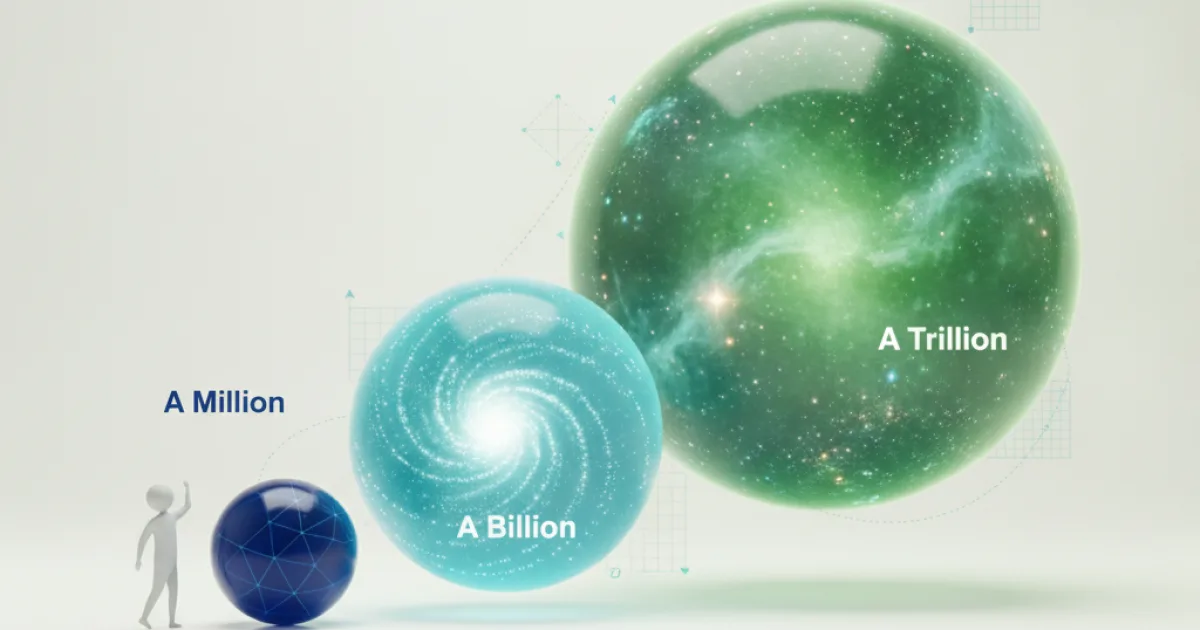
To grasp the vastness of a billion, it helps to compare it to other large numbers like a million and a trillion. A billion is 1,000 times larger than a million, and a trillion is 1,000 times larger than a billion. The time required to count to each number grows dramatically.
| Target Number | At 1 number per second without stopping | At 1 number per second, 8 hours per day | What it shows |
|---|---|---|---|
| 1 million | About 11.6 days | About 34.7 days | A manageable, but still lengthy, short-term project. |
| 1 billion | About 31.7 years | About 95.1 years | A task that spans decades, potentially a lifetime. |
| 1 trillion | About 31,689 years | About 95,066 years | A time frame that far exceeds human history. |
This simplified one-number-per-second estimate clearly illustrates how quickly the time commitment escalates with each factor of a thousand. Counting to a trillion, even theoretically, is an almost unimaginable endeavor for a single human.
Could a Person Realistically Count to One Billion?
Given the theoretical calculations and the practical challenges of spoken counting, it is highly improbable for a person to realistically count aloud to one billion in a single lifetime. The combination of the sheer number of counts, the time needed to pronounce large numbers, and the fundamental human need for rest makes it an extremely difficult, if not impossible, undertaking.
While someone might try to count silently or internally, the article focuses on spoken counting, which introduces the constraint of verbalization speed.
Could a Computer Count to One Billion?
A computer can process numbers at speeds vastly exceeding human capabilities. Counting to one billion internally (i.e., just incrementing a variable) would take a modern computer only a tiny fraction of a second, likely milliseconds or less, depending on the processor speed and other operations.
However, the time it takes depends on what the computer is doing:
- Internal counting: Extremely fast, almost instantaneous.
- Displaying every number: Slower, limited by screen refresh rates and output processing.
- Saving every number to a file: Slower still, limited by disk write speeds.
- Speaking every number aloud: This would involve text-to-speech conversion and audio output, which would be much slower than internal counting, potentially taking hours or days depending on the speed of the speech synthesizer and the complexity of the numbers.
Even for a computer, the act of "speaking" or outputting each number, especially large ones, introduces significant time delays.
Practical Ways to Understand How Big a Billion Is
Since counting to a billion is so difficult, here are a few ways to visualize its scale:
- Time comparison: One million seconds is approximately 11.6 days. One billion seconds, however, is about 31.7 years. That's a huge difference!
- Multiples: A billion is 1,000 millions. Imagine having a stack of 1,000 separate stacks, each containing a million items.
- Counting vs. knowing: Simply knowing what one billion means is very different from experiencing the passage of time it takes to count to it. The number itself is easy to write (1,000,000,000), but its scale is profound.
Practice or Thinking Exercises
- Convert 1 million seconds into days: How many days would 1,000,000 seconds be?
- Estimate how long 2 billion seconds would be in years: If 1 billion seconds is about 31.7 years, what about 2 billion?
- Explain why one number per second is not realistic for spoken counting: What factors make a human count slower than one number per second for large numbers?
- Compare 1 billion and 1 trillion: How much larger is a trillion compared to a billion?
Answers to Practice Exercises
- Convert 1 million seconds into days: 1,000,000 seconds ÷ 60 seconds/minute ÷ 60 minutes/hour ÷ 24 hours/day = approximately 11.57 days.
- Estimate how long 2 billion seconds would be in years: If 1 billion seconds is about 31.7 years, then 2 billion seconds would be approximately double that, or about 63.4 years.
- Explain why one number per second is not realistic for spoken counting: As numbers get larger, they require more words to say (e.g., "three hundred forty-five million"). This verbalization takes more than one second, slowing down the overall counting rate.
- Compare 1 billion and 1 trillion: A trillion is 1,000 times larger than a billion. It takes 1,000 billions to make one trillion.
Frequently Asked Questions (FAQs)
1. How many years is one billion seconds?
One billion seconds is approximately 31.7 years when calculated continuously without any breaks.
2. Could a person count to one billion in a lifetime?
It is highly unlikely for a person to count aloud to one billion within a typical human lifespan. Even counting at a theoretical rate of one number per second for 8 hours a day would take about 95 years, and actual spoken counting would be much slower.
3. How long would it take to count to a million?
Counting to one million at a rate of one number per second without stopping would take about 11.6 days. If counting for 8 hours per day, it would take approximately 34.7 days.
4. How long would it take to count to a trillion?
Counting to one trillion at one number per second without stopping would take approximately 31,689 years. If counting 8 hours per day, it would take about 95,066 years.
5. Why does counting aloud take longer than one number per second?
Counting aloud takes longer because larger numbers are multi-word phrases (e.g., "one hundred twenty-three thousand four hundred fifty-six") that take more than one second to pronounce clearly. The one-number-per-second rate is only practical for very small numbers.
Summary
Counting to a billion is a massive undertaking that vividly illustrates the scale of large numbers. While a theoretical one-number-per-second pace suggests it would take about 31.7 years of continuous counting, realistic human counting, with breaks and the need to vocalize longer numbers, would extend this time significantly, likely beyond a single lifetime. Understanding these calculations helps us appreciate the true magnitude of a billion, far beyond simply writing the digits.