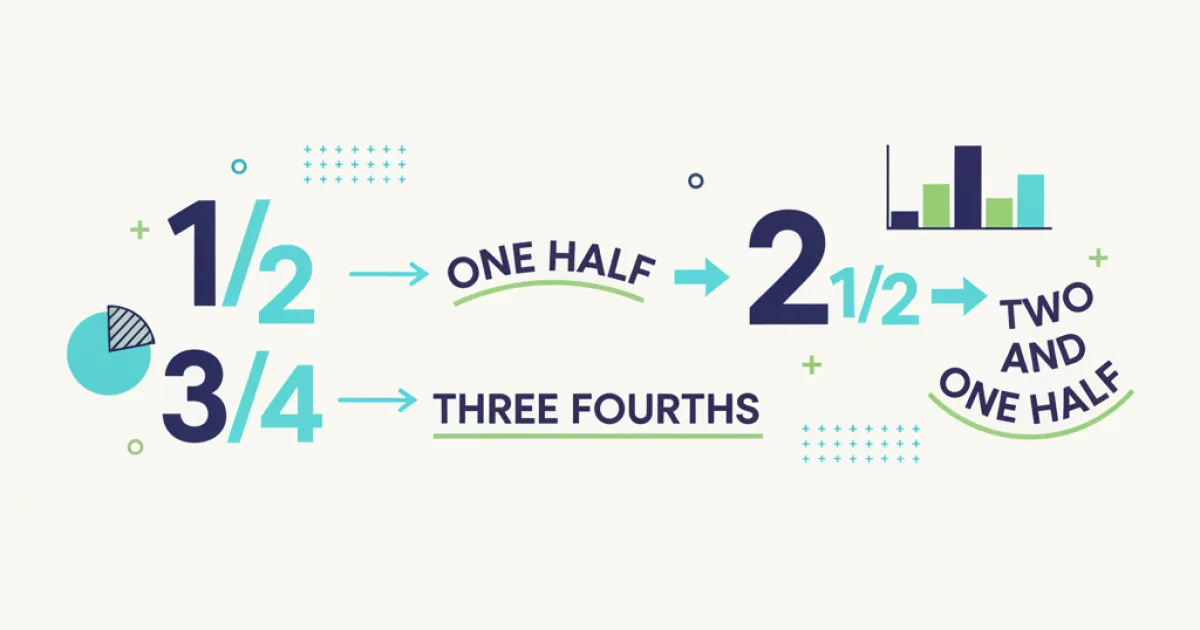
Fractions are usually read by saying the numerator first and then the denominator as an ordinal word. For example, 2/3 is read as “two thirds.” Some common fractions have special forms: 1/2 is “one half,” and 3/4 can be read as “three fourths” or “three quarters.” Learning these forms helps you clearly communicate numerical parts.
Quick Answer
To read and write fractions in words, first say the numerator (top number) and then the denominator (bottom number) as an ordinal fraction word. For instance, 2/5 is "two fifths." Remember special forms for common fractions, such as "one half" for 1/2 and "one quarter" for 1/4.
What is a Fraction?
A fraction represents a part of a whole. It consists of two main parts:
- The numerator is the top number, which tells you how many parts you have.
- The denominator is the bottom number, which tells you how many equal parts make up the whole.
For example, in the fraction 3/4, the number 3 is the numerator, and 4 is the denominator.
Key Rule
For most fractions, say the top number normally and the bottom number as an ordinal fraction word. If the numerator is greater than 1, the denominator word is usually plural.
How to Read Simple Fractions
To read simple fractions, say the numerator (top number) as a cardinal number and the denominator (bottom number) as an ordinal number. The numerator tells "how many" parts, and the denominator tells "what kind." For a numerator of 1, the denominator is singular (e.g., 1/3 is "one third"). If greater than 1, it's usually plural (e.g., 2/3 is "two thirds," 1/5 is "one fifth," 2/5 is "two fifths," 5/8 is "five eighths").
Step-by-Step: 3/4 in Words
- Identify the numerator: The top number is 3.
- Identify the denominator: The bottom number is 4.
- Convert the denominator to its ordinal form: The ordinal form for 4 is "fourth." Since the numerator (3) is greater than 1, the plural form "fourths" is used.
- Consider alternative forms: For the denominator 4, "quarter" is also a very common option, so it can be "quarters."
- Combine the parts: Read 3/4 as "three fourths" or "three quarters."
Special Fraction Words: Half and Quarter
Some fractions have widely recognized special word forms. 1/2 is almost always read as "one half," not "one second," in ordinary mathematical fraction reading. 2/2 can be read as "two halves." For 1/4, you can use "one fourth" or "one quarter." Similarly, 3/4 can be "three fourths" or "three quarters"; "quarter" is especially common in everyday English.
How to Read Mixed Numbers
A mixed number combines a whole number and a fraction. When reading mixed numbers, you state the whole number first, then the word "and," and finally the fractional part. For example, 2 1/2 is read as "two and one half." 3 3/4 is read as "three and three fourths" or "three and three quarters." The word "and" connects the whole number and its fractional component.
Fractions and Decimal-Place Words
Fractional concepts also extend to reading decimal numbers. The words used for decimal places are indeed fraction words. For instance, 0.1 is read as "one tenth," 0.01 is read as "one hundredth," and 0.05 is read as "five hundredths." This connection highlights how decimals are essentially fractions with denominators that are powers of ten.
Common Mistake
Wrong: Reading 1/2 as "one second."
Correct: Reading 1/2 as "one half."
Why: In ordinary mathematical fraction reading, the denominator 2 uses the special word forms "half" (singular) or "halves" (plural), rather than the ordinal "second" or "seconds."
Comparison Table
| Fraction | Word form | Alternative form | What to notice |
|---|---|---|---|
| 1/2 | one half | Special form, not "one second." | |
| 1/3 | one third | Numerator is 1, denominator is singular. | |
| 2/3 | two thirds | Numerator > 1, denominator is plural. | |
| 1/4 | one fourth | one quarter | Both forms are common. |
| 3/4 | three fourths | three quarters | Both forms are common; "quarters" is often informal. |
| 1/5 | one fifth | Standard ordinal form. | |
| 2/5 | two fifths | Plural denominator. | |
| 5/8 | five eighths | Standard ordinal form, plural. | |
| 7/10 | seven tenths | Denominator is a power of ten. | |
| 5/100 | five hundredths | Not "five hundreds"; relates to decimal places. | |
| 1/1000 | one thousandth | Singular form for numerator 1. | |
| 2 1/2 | two and one half | Mixed number: whole number + "and" + fraction. | |
| 3 3/4 | three and three fourths | three and three quarters | Mixed number with common alternative fraction forms. |
Common Mistakes
Understanding how to read fractions correctly also involves being aware of common errors:
- Reading 1/2 as "one second": As noted, "one half" is the standard.
- Forgetting pluralization: Saying "two third" instead of "two thirds" is a common error.
- Confusing hundredths with hundreds: Forgetting the "ths" sound can lead to saying "five hundreds" for 5/100, which is incorrect. It should be "five hundredths."
- Ignoring alternative forms for 1/4 and 3/4: Assuming "one fourth" is the only correct way for 1/4 overlooks the equally common "one quarter."
- Omitting the whole number or "and" in mixed numbers: Reading 2 1/2 simply as "one half" without the "two and" part is a significant omission.
- Confusing fraction words with ordinal positions: While words like "third" and "fourth" are ordinals, their use in fractions is specific to denoting parts of a whole, not a position in a sequence.
Quick Practice
- Write 1/2 in words.
- Write 2/3 in words.
- Write 3/4 in two possible ways.
- Write 5/100 in words.
- Write 2 1/2 in words.
- Explain why 1/2 is not usually read as “one second.”
Answers
- one half
- two thirds
- three fourths or three quarters
- five hundredths
- two and one half
- In ordinary fraction reading, 1/2 is typically read as "one half." The word "second" is used for ordinal positions (like in a race) but not for the denominator of a fraction in this common usage.
Related Tools and Practice
Number to Words Converter
Convert any number, including decimals and large numbers, into English words quickly and accurately.
Printable Math Worksheets
Access a variety of free printable worksheets to practice fractions, number words, and other math skills.
Interactive Math Quizzes
Test your understanding of fractions, number words, and mathematical concepts with engaging quizzes.
FAQs
1. How do you read fractions in words?
Read the numerator as a cardinal number and the denominator as an ordinal word. Use singular for a numerator of 1 (e.g., one third), and plural for numerators greater than 1 (e.g., two thirds).
2. How do you write 1/2 in words?
Write and read 1/2 as "one half." This is the standard form, not "one second," in typical fraction use.
3. Is 3/4 three fourths or three quarters?
Both "three fourths" and "three quarters" are correct. "Three quarters" is very common, especially informally.
4. How do you read mixed numbers like 2 1/2?
Read the whole number, then say "and," followed by the fractional part. So, 2 1/2 is "two and one half."
5. Why is 5/100 read as five hundredths?
The 'ths' ending shows it's a fractional part (hundredth), distinguishing it from 'hundreds' (whole units).
6. Is “one over two” the same as “one half”?
'One half' is the standard word form for the value. 'One over two' describes the notation (1/2) or a division expression, but not the primary word form for the quantity.
Practical Summary
Reading and writing fractions in words follows a clear pattern: state the numerator first, then the denominator as an ordinal word, pluralizing if the numerator is greater than one. Remember special forms like "one half" for 1/2 and the option of "quarter" for denominators of 4. For mixed numbers, connect the whole number and fraction with "and."