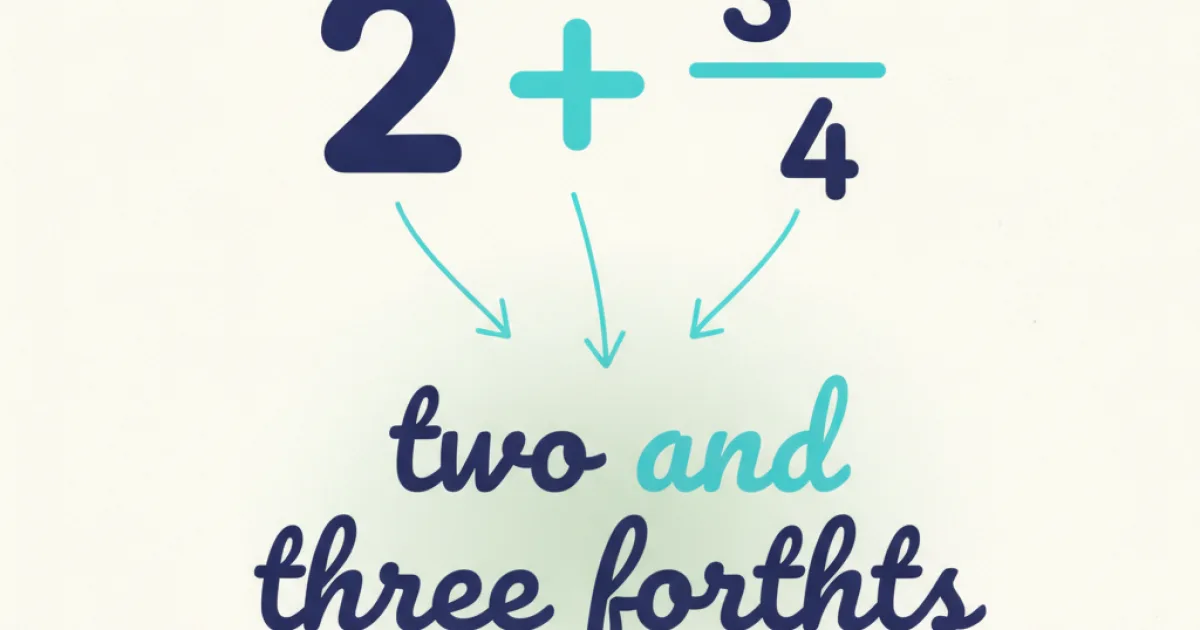
A mixed number is read in words by saying the whole number first, then "and," then the fraction. For example, 2 3/4 is read as "two and three fourths" or "two and three quarters." The word "and" connects the whole-number part and the fraction part, so 2 3/4 is not normally read as "two three fourths." To read a mixed number in words, say the whole number first, then "and," then the fraction, such as "two and three fourths" for 2 3/4.
Quick Answer
To read a mixed number in words, say the whole number first, then "and," and finally the fraction. For instance, 2 3/4 is read as "two and three fourths" or "two and three quarters." The word "and" is crucial as it clearly connects the whole-number part to its accompanying fraction part.
What Is a Mixed Number?
A mixed number combines a whole number and a fraction. It represents a value that is greater than the whole-number part but less than the next whole number. For example, in the mixed number 2 3/4, the "2" is the whole-number part, and "3/4" is the fraction part. This means you have two full units and three-quarters of another unit.
Key Rule
To express a mixed number in words, always read the whole-number part first, then say "and," and finally read the fraction part.
How to Read Mixed Numbers in Words
Reading mixed numbers in words follows a straightforward pattern. First, state the whole-number part. Second, say the word "and." Third, read the fraction part as you would any other fraction. The word "and" serves as a separator, indicating the transition from the whole amount to the fractional amount.
For instance, if you see 3 2/5, you would read it as "three and two fifths." This structure makes it clear that you are referring to a value that includes both a complete whole number and an additional fractional portion.
Step-by-Step: 2 3/4 in Words
Let's break down how to read and write 2 3/4 in words:
- Start with the mixed number: We have 2 3/4.
- Identify the whole-number part: The whole number is 2.
- Write the whole-number part in words: "two."
- Identify the fraction part: The fraction is 3/4.
- Write the fraction part in words: 3/4 can be written as "three fourths" or "three quarters."
- Connect with "and": Add the word "and" between the whole-number part and the fraction part.
- Combine for the full word form: The result is "two and three fourths" or "two and three quarters."
How to Write Mixed Numbers in Words
Writing mixed numbers in words involves converting each part into its word form and joining them correctly. Here's how to do it:
- Convert the whole-number part: Write the whole number as you normally would (e.g., 4 becomes "four").
- Convert the fraction part: Write the numerator, then the denominator (e.g., 1/3 becomes "one third," 5/8 becomes "five eighths"). Remember to use plural denominators when the numerator is greater than one (e.g., two fifths).
- Join with "and": Place the word "and" between the whole-number word form and the fraction word form.
Examples:
- 4 1/3 is written as "four and one third."
- 5 5/8 is written as "five and five eighths."
Special Fraction Words: Half and Quarter
Some fractions have common alternative word forms that are widely used:
- For 1/2: While "one second" is technically correct, it is almost always referred to as "one half" or simply "a half." So, 1 1/2 is commonly read as "one and a half," though "one and one half" is also correct.
- For 1/4 and 3/4: These can be expressed using "fourths" or "quarters." For example, 6 1/4 can be "six and one fourth" or "six and one quarter." Similarly, 2 3/4 can be "two and three fourths" or "two and three quarters." Both "fourths" and "quarters" are acceptable and widely understood in many contexts.
Mixed Numbers vs. Improper Fractions
It's important to distinguish between mixed numbers and improper fractions, especially when reading them in words. An improper fraction is a fraction where the numerator is greater than or equal to the denominator, such as 11/4.
- Reading an improper fraction: 11/4 is typically read as "eleven fourths."
- Converting to a mixed number: The improper fraction 11/4 is equivalent to the mixed number 2 3/4.
- Reading the mixed number form: As a mixed number, 2 3/4 is read as "two and three fourths" or "two and three quarters."
While they represent the same value, their word forms are different because they describe the number's structure in different ways.
Why Mixed Numbers Use "And"
The word "and" in a mixed number serves a specific mathematical purpose: it connects the whole-number part to the fraction part. A mixed number like 2 3/4 literally means "2 plus 3/4." The "and" signifies this addition or combination of a whole quantity and a fractional quantity.
This use of "and" is distinct from its optional use within whole numbers, such as saying "one hundred and five" for 105 (where "and" is sometimes omitted to be simply "one hundred five"). In mixed numbers, "and" is generally considered essential for clarity and proper mathematical phrasing.
Common Mistake
Wrong: Reading 2 3/4 as "two three fourths."
Correct: It is usually read as "two and three fourths" or "two and three quarters."
Why: The word "and" is essential in mixed numbers to connect the whole-number part and the fraction part, showing they are distinct but combined components of a single value.
Comparison Table: Mixed Numbers in Words
| Mixed Number or Fraction | Word Form | What the Parts Mean | Common Mistake | What to Notice |
|---|---|---|---|---|
| 1 1/2 | one and a half | 1 whole + 1/2 | one and one second | "A half" is common for 1/2. |
| 2 3/4 | two and three fourths (or two and three quarters) | 2 wholes + 3/4 | two three fourths | "And" connects whole and fraction. "Fourths" and "quarters" are interchangeable here. |
| 6 1/4 | six and one fourth (or six and one quarter) | 6 wholes + 1/4 | six one fourth | "One fourth" or "one quarter" for 1/4. |
| 3 2/5 | three and two fifths | 3 wholes + 2/5 | three and two five | Denominator takes plural form ("fifths"). |
| 4 1/3 | four and one third | 4 wholes + 1/3 | four and one three | "Third" for 1/3. |
| 5 5/8 | five and five eighths | 5 wholes + 5/8 | five and five eight | Denominator takes plural form ("eighths"). |
| 11/4 | eleven fourths (as improper fraction) OR two and three fourths (as 2 3/4 mixed number) | 11/4 is > 1. Equals 2 wholes + 3/4 | reading 11/4 as "two and three fourths" without conversion | Improper fractions are read differently from their mixed number equivalents. |
Common Mistakes to Avoid
When reading or writing mixed numbers in words, be mindful of these common errors:
- Forgetting "and": Omitting "and" (e.g., "two three fourths" instead of "two and three fourths") is a frequent mistake that can lead to confusion.
- Incorrect fraction wording for 1/2: Saying "one and one second" for 1 1/2 is technically literal but not common. "One and a half" is the standard phrasing.
- Confusing improper fractions with mixed numbers: Remember that 11/4 is "eleven fourths," while its mixed number form 2 3/4 is "two and three fourths." They are different word forms for the same value.
- Singular vs. Plural Denominators: Ensure the denominator word matches the numerator. Use "one third" but "two thirds," "one fifth" but "two fifths," and so on.
Quick Practice
- Write 1 1/2 in words.
- Write 2 3/4 in words.
- Write 4 1/3 in words.
- Write 6 1/4 in words.
- Write 3 5/8 in words.
- Which is better for 2 3/4: "two three fourths" or "two and three fourths"?
Answers
- one and a half
- two and three fourths (or two and three quarters)
- four and one third
- six and one fourth (or six and one quarter)
- three and five eighths
- "two and three fourths" is better, as "and" connects the whole number and the fraction.
FAQs
How do you read mixed numbers in words?
You read mixed numbers by stating the whole number first, then adding "and," and finally reading the fraction. For example, 5 1/2 is read as "five and one half."
How do you write 2 3/4 in words?
The mixed number 2 3/4 is written in words as "two and three fourths" or "two and three quarters." Both "fourths" and "quarters" are commonly accepted for 1/4 and 3/4.
How do you write 1 1/2 in words?
The mixed number 1 1/2 is typically written as "one and a half" or "one and one half." The phrasing "one and a half" is very common in everyday language.
Why do mixed numbers use "and"?
In mixed numbers, "and" is used to clearly separate and connect the whole-number part from the fraction part. It signifies that the number is a sum of a whole quantity and a fractional quantity, making the meaning unambiguous.
What is the difference between a mixed number and an improper fraction?
A mixed number combines a whole number and a fraction (e.g., 2 3/4), while an improper fraction has a numerator that is greater than or equal to its denominator (e.g., 11/4). They represent the same value but are written and read differently.
Is "three quarters" the same as "three fourths"?
Yes, "three quarters" and "three fourths" refer to the exact same value (3/4). "Quarters" is a common alternative word for "fourths," especially when referring to parts of a whole.
Reading and writing mixed numbers in words becomes simple once you understand the core pattern: state the whole number, add "and," then state the fraction. Remember to use "and" to clearly connect the whole and fractional parts, and be mindful of special fraction words like "half" and "quarter." With practice, you'll confidently express mixed numbers in their correct word form.