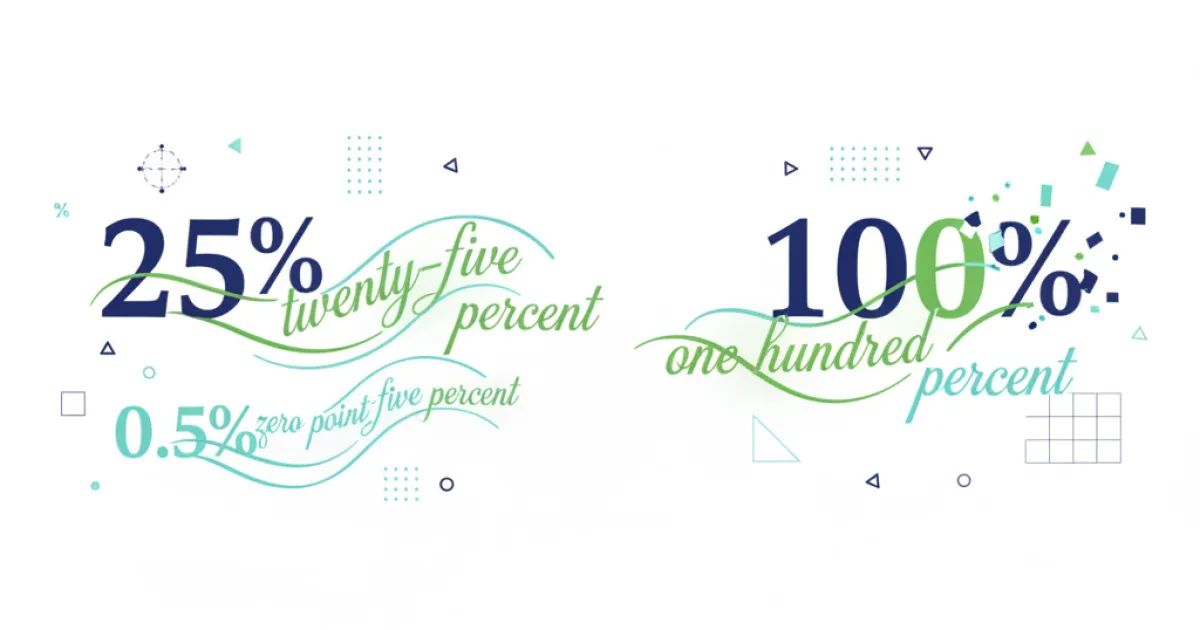
To read a percentage in words, read the number first and then say “percent.” For example, 25% is “twenty-five percent,” 0.5% is “zero point five percent,” 100% is “one hundred percent,” and 150% is “one hundred fifty percent.”
Quick Answer
To read a percentage in words, first read the number, then say "percent." For instance, 25% is twenty-five percent, 0.5% is zero point five percent, and 100% is one hundred percent. This simple rule applies to most percentages.
What Does the Percent Sign (%) Mean?
The percent sign (%), which you see in expressions like 25% or 0.5%, is simply read as "percent." The word "percent" itself comes from the Latin "per centum," meaning "per hundred" or "out of one hundred." So, when you see 25%, it means "25 out of 100."
While understanding its meaning helps, our focus here is on how to correctly speak and write these values in English words, rather than on advanced calculations. The fundamental idea is that a percentage expresses a proportion of a whole, specifically a proportion with a denominator of 100.
Key Rule
To write a percentage in words, write the number in words and then add the word "percent."
How to Read and Write Whole-Number Percentages
Reading whole-number percentages is straightforward. You simply read the number as you normally would, and then you add the word "percent" after it. This applies whether the number is small or large.
- 1%: one percent
- 5%: five percent
- 10%: ten percent
- 25%: twenty-five percent
- 50%: fifty percent
- 100%: one hundred percent
For example, if a report states that "10% of students achieved an A grade," you would read that as "ten percent of students achieved an A grade."
How to Read and Write Decimal Percentages
Decimal percentages follow the same core rule: read the number, then say "percent." The key is to read the decimal number correctly first. We commonly read the decimal point as "point," followed by each digit individually.
- 0.5%: zero point five percent
- 0.05%: zero point zero five percent
- 0.25%: zero point two five percent
- 99.9%: ninety-nine point nine percent
It is important to be precise when reading decimal percentages, as a misplaced or misread decimal point can significantly change the value. For instance, 0.5% is a very different value from 50%.
In some explanatory contexts, 0.5% may also be described as "one half of one percent," which can help clarify its small value compared to a full percent.
Step-by-Step Breakdown: 0.5% vs 50%
Understanding the difference between 0.5% and 50% is crucial, as they represent vastly different values. Let's break down how to read them:
- Step 1: Read the number 0.5. This is read as "zero point five."
- Step 2: Add the word "percent." So, 0.5% is "zero point five percent."
- Step 3: Read the number 50. This is read as "fifty."
- Step 4: Add the word "percent." So, 50% is "fifty percent."
- Step 5: Compare the values. 0.5% is a very small fraction (half of one percent), while 50% is half of a whole. They are not the same value.
Reading Percentages Over 100%
It's a common misconception that percentages cannot exceed 100%. However, percentages can indeed be greater than 100% in many contexts, such as growth, increases, or comparisons. The reading rule remains the same: read the number, then say "percent."
- 150%: one hundred fifty percent (commonly heard in American English)
- 150%: one hundred and fifty percent (may be heard in some other varieties of English)
- 200%: two hundred percent
- 1,000%: one thousand percent
For example, if a company's sales increased by 150%, you would say "one hundred fifty percent." This means the sales are now 1.5 times their original value, or 150 out of every 100 of the original value.
Percent, Percentage, and Percentage Point: A Quick Distinction
While related, "percent," "percentage," and "percentage point" refer to different aspects:
- Percent: This is the unit used with a number to express a value out of one hundred (e.g., 25 percent).
- Percentage: This term refers to the general concept or a proportion expressed in hundredths (e.g., "What is the percentage of students who passed?").
- Percentage Point: This describes the arithmetic difference between two percentage values. For instance, if a success rate increased from 5% to 6%, that's an increase of 1 percentage point, not 1 percent. Saying "1 percent increase" could be ambiguous, as it might imply a 1% increase of the original 5% (which would be 0.05%). For clarity, use "percentage point" when discussing the difference between two percentages.
Common Mistake
Wrong: Assuming 0.5% is the same as 50%.
Correct: 0.5% is zero point five percent, while 50% is fifty percent.
Why: The decimal point significantly changes the value of the number before the percent sign. 0.5% means half of one percent, whereas 50% means half of a whole.
Percentage Word Forms Comparison Table
| Percentage | Word form | Helpful meaning | What to notice |
|---|---|---|---|
| 1% | one percent | One out of one hundred | Basic whole number. |
| 5% | five percent | Five out of one hundred | Simple whole number. |
| 10% | ten percent | Ten out of one hundred | Common whole number. |
| 25% | twenty-five percent | Twenty-five out of one hundred (one quarter) | Read number, then "percent." |
| 50% | fifty percent | Fifty out of one hundred (one half of a whole) | A significant portion. |
| 0.5% | zero point five percent | Zero point five out of one hundred (one half of one percent) | Decimal point is crucial; not 50%. |
| 0.05% | zero point zero five percent | Zero point zero five out of one hundred | Each digit after the decimal is read. Not 5%. |
| 0.25% | zero point two five percent | Zero point two five out of one hundred (one quarter of one percent) | Read digits after "point." |
| 99.9% | ninety-nine point nine percent | Ninety-nine point nine out of one hundred | Decimal values are read clearly. |
| 100% | one hundred percent | One hundred out of one hundred (a whole) | Represents the entire amount. |
| 150% | one hundred fifty percent | One hundred fifty out of one hundred (one and a half times the whole) | Percentages can exceed 100%. |
| 200% | two hundred percent | Two hundred out of one hundred (twice the whole) | Represents double the amount. |
| 1,000% | one thousand percent | One thousand out of one hundred (ten times the whole) | Larger values are read normally. |
Common Mistakes to Avoid
When reading and writing percentages, some common errors can lead to confusion:
- Redundancy: Do not say "25% percent." The percent sign (%) already means "percent."
- Misreading decimals: Confusing 0.5% ("zero point five percent") with 50% ("fifty percent"). These are very different values.
- Misreading small decimals: Interpreting 0.05% ("zero point zero five percent") as 5% ("five percent"). Each digit after the decimal point must be read.
- Limiting percentages to 100%: Assuming that percentages cannot be greater than 100%. They often are in contexts of growth or increase.
- Confusing "percent" and "percentage point": Remember, "percent" is the unit, while "percentage point" is the difference between two percentages.
- Forgetting "point": Neglecting to say "point" when reading decimal percentages (e.g., saying "zero five percent" instead of "zero point five percent").
- Using "percentage" instead of "percent": "Percent" is used with a number (e.g., "25 percent"), while "percentage" refers to the general concept (e.g., "a high percentage").
Quick Practice
Test your understanding with these quick questions:
- Write 25% in words.
- Write 0.5% in words.
- Write 0.05% in words.
- Write 100% in words.
- Write 150% in words.
- Which is larger: 0.5% or 50%?
Answers
- twenty-five percent
- zero point five percent
- zero point zero five percent
- one hundred percent
- one hundred fifty percent
- 50% is much larger than 0.5%.
Frequently Asked Questions (FAQs)
How do you read percentages in words? You typically read the number first, then add the word "percent." For example, 15% is "fifteen percent," and 2.5% is "two point five percent." How do you write 25% in words? 25% is written as "twenty-five percent." Always write out the number in words before adding "percent." How do you read 0.5%? 0.5% is read as "zero point five percent." It is important to pronounce the "point" and the digits after it clearly to avoid confusion with other values like 50%. Is 0.5% the same as 50%? No, 0.5% is not the same as 50%. 0.5% means half of one percent, which is a very small amount. 50% means fifty percent, which is half of a whole. They represent vastly different proportions. How do you write 100% and 150% in words? 100% is written as "one hundred percent." 150% is written as "one hundred fifty percent" (or "one hundred and fifty percent" in some English varieties). Percentages can indeed be greater than 100%. What is the difference between percent and percentage point? "Percent" is the unit used with a number (e.g., "5 percent"). "Percentage point" describes the absolute difference between two percentage values. For example, a change from 10% to 12% is a 2 percentage point increase.Summary
Reading and writing percentages in words follows a simple, consistent rule: state the number, then add "percent." Whether it's a whole number like "twenty-five percent" (25%) or a decimal like "zero point five percent" (0.5%), precision in reading the numerical part is key. Always be mindful of decimal points and remember that percentages can exceed 100%. Consistent practice helps reinforce these essential number word skills.