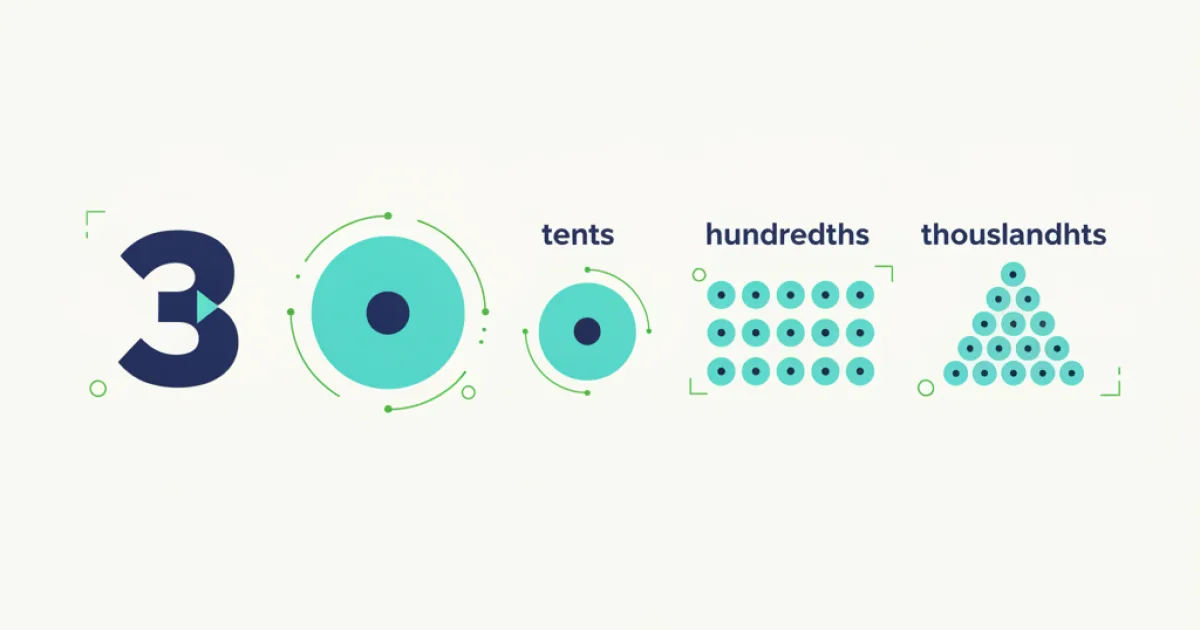
Decimal numbers can be read in words in two common ways. In everyday English, decimals are often read with “point,” such as 3.14 as “three point one four.” In math or place-value contexts, decimals may also be read as fractions, such as 0.25 as “twenty-five hundredths.” Understanding both approaches helps you communicate numbers clearly in different situations.
What is a Decimal Number?
A decimal number is a number that includes a whole number part and a fractional part, separated by a decimal point. The digits to the right of the decimal point represent parts of a whole, based on powers of ten. For example, in 2.5, '2' is the whole number part, and '.5' is the decimal part, representing five tenths of a whole.
Everyday Point Reading of Decimals
This is the most common way to read decimals in casual conversation or when precision in individual digits is important, such as reading phone numbers or measurements.
- First, read the whole-number part as usual. If there is no whole number (e.g., 0.5), you can say “zero” or simply omit it (e.g., “point five”).
- Next, say the word “point” for the decimal separator.
- Finally, read each digit after the decimal point one by one. Do not group them into larger numbers.
Examples of Point Reading:
- 0.5: zero point five (or simply “point five”)
- 0.25: zero point two five
- 3.14: three point one four (not “three point fourteen”)
- 12.006: twelve point zero zero six
- 3.1416: three point one four one six
Fractional Place-Value Reading
In more formal math settings or when emphasizing the fractional value of the decimal, you might read decimals using their place values. This method treats the decimal part as a fraction.
- Read the whole-number part first.
- Say “and” for the decimal point.
- Read the digits after the decimal point as a whole number.
- Identify the place value of the last digit (tenths, hundredths, thousandths, etc.) and add that word.
Examples of Fractional Place-Value Reading:
- 0.5: five tenths (the '5' is in the tenths place)
- 0.25: twenty-five hundredths (the '5' is in the hundredths place)
- 0.007: seven thousandths (the '7' is in the thousandths place)
- 2.5: two and five tenths
- 3.14: three and fourteen hundredths
- 12.006: twelve and six thousandths
Tenths, Hundredths, and Thousandths
The place value of a digit after the decimal point tells us its fractional equivalent:
- First digit after the point: Tenths (e.g., 0.7 is seven tenths)
- Second digit after the point: Hundredths (e.g., 0.07 is seven hundredths)
- Third digit after the point: Thousandths (e.g., 0.007 is seven thousandths)
Notice how adding zeros after the decimal point but before other digits changes the place value significantly, making the number much smaller.
Why Leading Zeros After the Decimal Point Matter
Leading zeros between the decimal point and other non-zero digits are crucial because they determine the place value of the non-zero digits. They are not just for decoration and must be read.
- 0.7: This is seven tenths. The '7' is in the tenths place.
- 0.07: This is seven hundredths. The '7' is in the hundredths place, meaning it's ten times smaller than 0.7.
- 0.007: This is seven thousandths. The '7' is in the thousandths place, making it even smaller than 0.07.
Reading these zeros correctly, especially in point reading (e.g., “zero point zero seven”), ensures the value is understood.
How to Read Longer Decimals
For decimals with many digits after the point, such as Pi (3.14159...), the “point” reading method is usually preferred because the fractional place-value names become very long and less practical. It is much simpler to say “three point one four one five nine” than to try to use a fractional name for so many decimal places.
Decimal Point vs. Decimal Comma
This article uses the decimal point (e.g., 3.14) because it is common in English-language examples and in many regions, including the United States. However, it's important to know that in some countries and contexts, a decimal comma is used instead (e.g., 3,14). Readers should follow the format expected in their specific school, country, or document.
Comparison Table: Reading Decimals
| Decimal | Point Reading | Fractional Reading | What to Notice |
|---|---|---|---|
| 0.5 | zero point five | five tenths | One digit after the point is tenths. |
| 0.25 | zero point two five | twenty-five hundredths | Two digits after the point is hundredths. |
| 0.75 | zero point seven five | seventy-five hundredths | Reads like 75 over 100. |
| 0.7 | zero point seven | seven tenths | The '7' is in the tenths place. |
| 0.07 | zero point zero seven | seven hundredths | The '7' is in the hundredths place; note the leading zero. |
| 0.007 | zero point zero zero seven | seven thousandths | The '7' is in the thousandths place; note two leading zeros. |
| 2.5 | two point five | two and five tenths | Whole number plus the decimal part. |
| 3.14 | three point one four | three and fourteen hundredths | Careful point reading is digit by digit. |
| 12.006 | twelve point zero zero six | twelve and six thousandths | Don't forget to read the zeros in point reading. |
| 3.1416 | three point one four one six | (less common in practice) | Longer decimals are usually read digit by digit using “point.” |
Common Mistakes to Avoid
When reading decimal numbers, watch out for these typical errors:
- Reading digits after the point as a whole number in point reading: Saying “three point fourteen” for 3.14 is a common informal shortcut, but “three point one four” is clearer and more precise in careful reading.
- Confusing 0.7, 0.07, and 0.007: These are distinct values. Always pay attention to leading zeros after the decimal point.
- Forgetting to read zeros after the decimal point: For instance, 12.006 should be “twelve point zero zero six,” not “twelve point six.”
- Saying “hundreds” instead of “hundredths” or “thousands” instead of “thousandths”: The '-ths' ending is essential for decimal place values.
- Confusing decimal reading with money reading: While 0.25 can be twenty-five cents, reading it as “zero point two five” or “twenty-five hundredths” is about the number itself, not currency.
- Assuming decimal point and decimal comma are interchangeable everywhere: While both serve as decimal separators, their usage depends on regional conventions.
Practice Exercises
- Read 0.5 in point form.
- Read 0.5 in fractional form.
- Read 0.25 in point form.
- Read 0.25 in fractional form.
- Read 0.07 in words (both forms).
- Read 0.007 in words (both forms).
- Read 3.14 in careful point form.
- Explain the difference between 0.7 and 0.07.
Answers to Practice Exercises
- 0.5 in point form: zero point five
- 0.5 in fractional form: five tenths
- 0.25 in point form: zero point two five
- 0.25 in fractional form: twenty-five hundredths
- 0.07 in words: zero point zero seven, or seven hundredths
- 0.007 in words: zero point zero zero seven, or seven thousandths
- 3.14 in careful point form: three point one four
- Difference between 0.7 and 0.07: 0.7 is seven tenths (7/10), while 0.07 is seven hundredths (7/100). 0.7 is ten times larger than 0.07 because the '7' is in a different place value.
Quiz or Worksheet Connection
Want more practice? Try a decimal numbers worksheet or number words quiz on Number-Digit.com to reinforce your understanding.
Frequently Asked Questions (FAQs)
1. How do you read decimal numbers in words?
You can read them in two main ways: using “point” (e.g., 3.14 as “three point one four”) or using fractional place values (e.g., 0.25 as “twenty-five hundredths”). The choice often depends on context, with “point” being more common for everyday use and longer decimals.
2. Is 0.5 “zero point five” or “five tenths”?
Both are correct ways to read 0.5. “Zero point five” is the everyday “point” reading, while “five tenths” uses the fractional place-value method. You may choose based on clarity or formality.
3. How do you read 0.25 in words?
0.25 can be read as “zero point two five” (point reading) or “twenty-five hundredths” (fractional place-value reading). Both are widely understood.
4. What is the difference between tenths and hundredths?
Tenths refer to the first digit after the decimal point, representing a division by 10 (e.g., 0.1 is one tenth). Hundredths refer to the second digit after the decimal point, representing a division by 100 (e.g., 0.01 is one hundredth). One tenth is equivalent to ten hundredths.
5. How do you read zeros after the decimal point?
In point reading, you must read each zero individually (e.g., 0.07 is “zero point zero seven”). In fractional reading, these zeros affect the place value of the non-zero digit (e.g., 0.07 is “seven hundredths,” not “seven tenths”).
6. Should I use a decimal point or decimal comma?
For English-language examples, a decimal point is commonly used. However, some countries and specific documents use a decimal comma. Always follow the convention expected in your particular context, school, or region.
Short Practical Summary
Reading decimal numbers in words involves two main methods: the everyday “point” reading, where digits are read individually after “point,” and the more formal fractional place-value reading, which uses terms like tenths, hundredths, and thousandths. Understanding the role of leading zeros and distinguishing between these methods ensures accurate communication of numerical values.