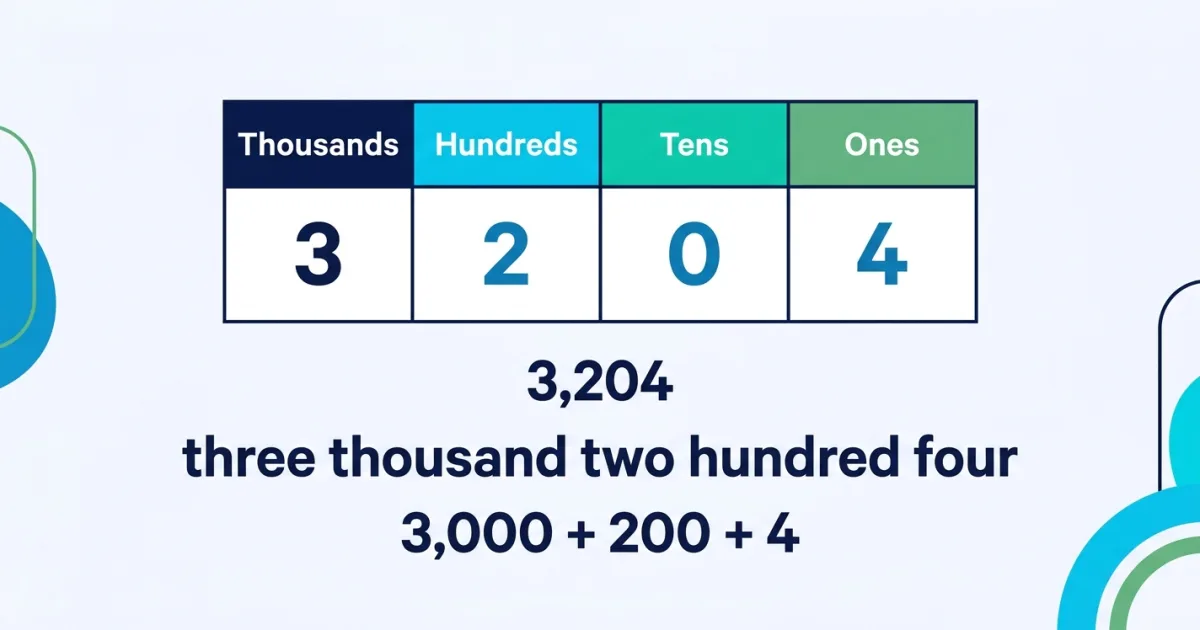
Standard form, word form, and expanded form are three primary ways to write numbers based on place value. Standard form uses digits, word form writes the number in words, and expanded form shows the value of each place in the number. The core place-value rule is that every digit's position determines its actual value, meaning that placeholder zeros must be kept in standard form even if they are not spoken aloud in word form or written as terms in expanded form.
Standard form represents numbers using digits (e.g., 4,006). Word form expresses numbers using written words (e.g., four thousand six). Expanded form shows the sum of each digit's place value (e.g., 4,000 + 6). Placeholder zeros are silent in word form and omitted in expanded form, but they are required in standard form to keep other digits in their correct place-value positions.
Understanding the Three Number Forms
To work with numbers accurately, you must understand how each of the three forms represents place value.
What is Standard Form?
Standard form is the most common way to write numbers using digits from 0 to 9. Commas are used to separate groups of three digits (periods) in larger numbers, starting from the right. For example, 705 and 2,000,030 are written in standard form. This format is efficient, compact, and used in almost all mathematical calculations.
What is Word Form?
Word form, or numbers in word form, writes out the number using English words instead of digits. In standard American English, whole numbers are written without the word "and" (which is reserved for decimals). For example, 4,006 is written as "four thousand six." Word form is highly useful for spelling out amounts on legal documents or checks, though this article focuses entirely on general mathematical usage.
What is Expanded Form?
Expanded form shows a number stretched out into the sum of the values of each of its digits. For example, the expanded form of 3,204 is 3,000 + 200 + 4. This form helps learners visualize the actual value of each digit based on its position. Because zero-value places represent nothing to add, they are usually omitted from the addition expression.
The Zero Placement Rule: When converting from word form or expanded form back to standard form, every place value (thousands, hundreds, tens, ones) must be accounted for. If a place value is not mentioned in words or is missing from the expanded addition, you must write a 0 in that position to preserve the place values of the other digits.
Step-by-Step Conversion: 3,204
Converting a number like 3,204 between standard form, word form, and expanded form is straightforward when you break it down by place value.
- Identify the place values: Look at the digits of 3,204 from left to right. There is a 3 in the thousands place, a 2 in the hundreds place, a 0 in the tens place, and a 4 in the ones place.
- Write in expanded form: Express the value of each digit as an addition term. The 3 is worth 3,000, the 2 is worth 200, and the 4 is worth 4. Since the tens place is 0, omit it from the sum. The expanded form is 3,000 + 200 + 4.
- Write in word form: Read the non-zero place values from left to right. The 3,000 becomes "three thousand," the 200 becomes "two hundred," and the 4 becomes "four." Combine them to get "three thousand two hundred four."
Why Zeros Disappear in Words but Matter in Digits
In spoken English, we do not say empty place values. We do not say "four thousand, zero hundreds, zero tens, and six." We simply say "four thousand six." This makes word form efficient for speech, but it can lead to errors when converting back to digits.
In standard form, digits rely entirely on their position (place value) to convey meaning. Without the placeholder zeros in 4,006, the number becomes 46, which is forty-six—a completely different value. Each group of three digits after a comma must keep its place to maintain the overall value of the number.
Incorrect: Writing "four thousand six" as 46. Correct: Writing "four thousand six" as 4,006. Reason: Without the two placeholder zeros in the hundreds and tens places, the digit 4 slides into the tens place, changing its value from four thousand to forty.
Comparison of Number Forms
The following table compares standard form, word form, and expanded form for numbers that contain placeholder zeros, highlighting the common mistakes that occur when zeros are missed.
| Standard Form | Word Form | Expanded Form | Common Mistake | Why It Happens |
|---|---|---|---|---|
| 4,006 | four thousand six | 4,000 + 6 | 46 | Omitting the placeholder zeros for the hundreds and tens places. |
| 705 | seven hundred five | 700 + 5 | 75 | Forgetting the zero in the tens place, making it look like seventy-five. |
| 6,050 | six thousand fifty | 6,000 + 50 | 650 | Confusing sixty with six hundred or omitting the placeholder in the hundreds place. |
| 2,000,030 | two million thirty | 2,000,000 + 30 | 2,030 | Failing to fill the empty hundred-thousands, ten-thousands, thousands, and hundreds places with zeros. |
| 70,008 | seventy thousand eight | 70,000 + 8 | 708 or 70,080 | Omitting the empty hundreds and tens places, or misplacing the final digit. |
How to Avoid Missing Zeros
To prevent errors when converting word form to standard form, follow these practical strategies:
- Use Place-Value Dash Templates: If you hear "seventy thousand eight," draw dashes for each place value up to the ten-thousands place: _ _ , _ _ _ . Fill in the known digits (7 in the ten-thousands place, 8 in the ones place) and fill all empty dashes with zeros to get 70,008.
- Count Digits in Expanded Form: When converting 70,000 + 8, note that 70,000 has five digits. Your final standard form number must also have five digits. Writing "78" only gives you two digits, which signals an error.
- Read the Number Back: After writing a number in standard form, read it aloud to see if it matches the original word form. Reading "705" aloud is "seven hundred five," whereas reading "75" is "seventy-five."
Quick Practice
- Write 3,204 in word form.
- Write six thousand fifty in standard form.
- Write 7,080 in expanded form.
- Which is correct for four thousand six: 46 or 4,006?
- Write 2,000,030 in word form.
- Write seventy thousand eight in standard form.
Answers
- three thousand two hundred four.
- 6,050.
- 7,000 + 80.
- 4,006.
- two million thirty.
- 70,008.
Related Tools and Practice
FAQs
What is the difference between standard form, word form, and expanded form?
Standard form uses digits to write a number (e.g., 4,006), word form writes the number using words (e.g., four thousand six), and expanded form shows the sum of the values of each digit (e.g., 4,000 + 6).
Why does word form not say every zero?
Word form is designed for spoken language, which naturally skips empty place values for efficiency. Instead of saying "four thousand, zero hundreds, zero tens, and six," we simply say "four thousand six."
Is four thousand six written as 46 or 4,006?
It is written as 4,006. Writing 46 represents forty-six. The zeros in 4,006 act as placeholders to keep the 4 in the thousands place.
How do I convert word form to standard form?
To convert word form to standard form, identify the largest place value mentioned, set up blank spaces for each place value down to the ones place, and fill in the digits. Write a 0 in any place value that is not mentioned in the words.
How do I write expanded form when a number has zeros?
When writing a number with zeros in expanded form, you usually omit the zero terms. For example, 705 is written as 700 + 5, rather than 700 + 0 + 5. However, the placeholder values are still implied.
Is expanded form the same as scientific notation?
No, expanded form is not the same as scientific notation. Expanded form writes a number as an addition expression of its place values (e.g., 300 + 20 + 4), while scientific notation writes a number as a product of a decimal and a power of 10 (e.g., 3.24 × 10²).
Summary
Understanding standard form, word form, and expanded form is essential for mastering place value. The most important rule to remember is that placeholder zeros are silent in word form and omitted in expanded form, but they must always be written in standard form to keep other digits in their correct positions. Forgetting these zeros turns large numbers like 4,006 into much smaller values like 46. Always check your place values when converting between these forms.