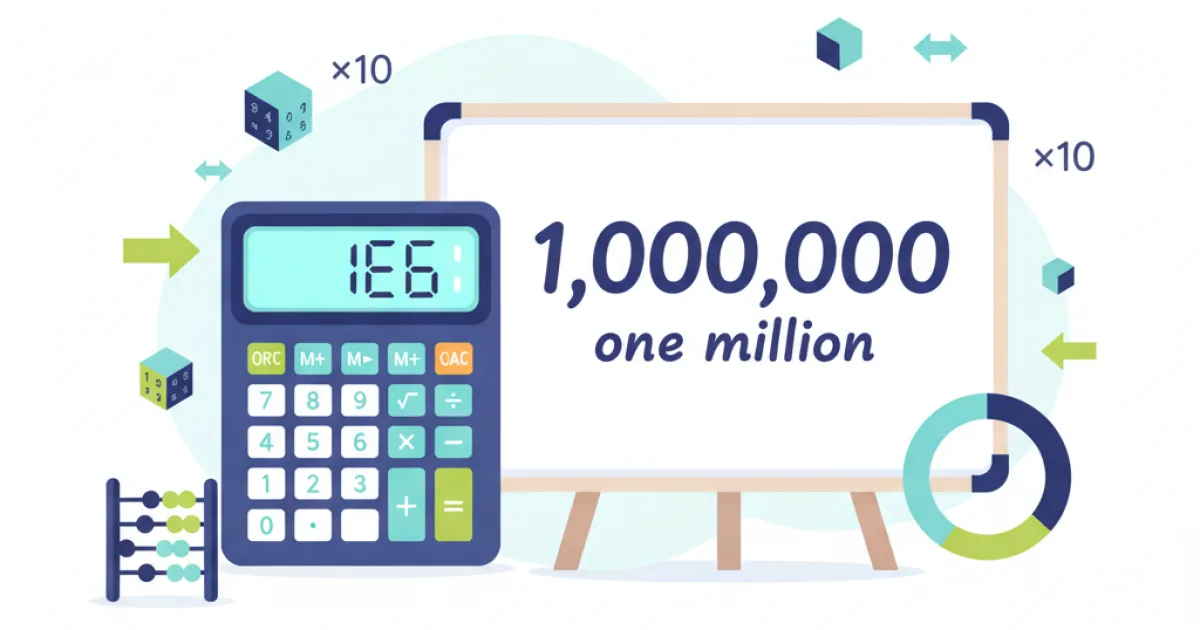
1E6 means 1 × 10⁶, which equals 1,000,000, or one million. In E notation, the letter E means “times ten to the power of,” so the number after E tells you how many places the decimal point moves.
Quick Answer
1E6 is a compact way to write 1,000,000. It stands for 1 multiplied by 10 to the power of 6 (1 × 10⁶). This value is also known as one million.
What Does 1E6 Mean?
When you see 1E6, especially on calculators, spreadsheets, or in data displays, it’s a shorthand for a very large number. The "E" stands for "exponent" and specifically means "times ten to the power of." So, 1E6 is read as "one times ten to the power of six."
- 1E6 is equivalent to 1 × 10⁶.
- 106 means 10 multiplied by itself six times (10 × 10 × 10 × 10 × 10 × 10), which results in 1,000,000.
- Therefore, 1E6 = 1,000,000.
- In words, 1,000,000 is one million.
This notation helps keep very large or very small numbers manageable on screens with limited space.
Key Rule
In E notation, aEb means a × 10b. The number after E tells you the power of ten, indicating how many places the decimal point shifts.
What E Means in Numbers
In the context of E notation, the letter E is not a variable or a mathematical constant like Euler's number (e ≈ 2.71828). Instead, it's an operator that simplifies scientific notation for display purposes.
- E stands for "times ten to the power of."
- The number before E (the 'a' in aEb) is the base number or coefficient.
- The number after E (the 'b' in aEb) is the exponent, which is the power of ten.
For example:
- 1E6 means 1 × 10⁶.
- 2.5E6 means 2.5 × 10⁶.
- A positive exponent after E, like 6 in 1E6, indicates a large number. It means you move the decimal point to the right.
- A negative exponent, like -3 in 1E-3, indicates a small number. It means you move the decimal point to the left.
Step-by-Step: 1E6 to One Million
Converting 1E6 to its ordinary number form is straightforward:
- Step 1: Read E as “times ten to the power of.” So, 1E6 becomes "one times ten to the power of six."
- Step 2: Translate to scientific notation. This gives us 1 × 10⁶.
- Step 3: Calculate the power of ten. 106 means 1 followed by 6 zeros, which is 1,000,000.
- Step 4: Multiply the base number. 1 × 1,000,000 equals 1,000,000.
- Step 5: State the number in words. 1,000,000 is one million.
E Notation and Powers of Ten
E notation is closely tied to powers of ten, which are fundamental for understanding large numbers. Each power of ten represents a specific magnitude:
- 103 = 1,000 (one thousand)
- 106 = 1,000,000 (one million)
- 109 = 1,000,000,000 (one billion, in the short scale)
- 1012 = 1,000,000,000,000 (one trillion, in the short scale)
This connection makes E notation a convenient way to express these large values without writing out all the zeros. The exponent directly tells you which power of ten is being used, making it easy to identify the number's magnitude and its common name.
Common Examples of E Notation
- 1E3:
- Scientific notation: 1 × 10³
- Ordinary number: 1,000
- In words: one thousand
- 1E6:
- Scientific notation: 1 × 10⁶
- Ordinary number: 1,000,000
- In words: one million
- 1E9:
- Scientific notation: 1 × 10⁹
- Ordinary number: 1,000,000,000
- In words: one billion (short scale)
- 1E12:
- Scientific notation: 1 × 10¹²
- Ordinary number: 1,000,000,000,000
- In words: one trillion (short scale)
- 2.5E6:
- Scientific notation: 2.5 × 10⁶
- Ordinary number: 2,500,000
- In words: two million five hundred thousand
- 3E8:
- Scientific notation: 3 × 10⁸
- Ordinary number: 300,000,000
- In words: three hundred million
E Notation in Calculators, Spreadsheets, and Data
E notation is widely used in digital environments where space is limited or numbers are too large or small for standard display. Many calculators, spreadsheets (like Microsoft Excel or Google Sheets), and programming languages automatically convert numbers into E notation when they exceed a certain digit count.
- A calculator might show
1000000as1E6. - A spreadsheet cell might display
2500000as2.5E+06(some systems add a plus sign for positive exponents). - This compact format ensures that even extremely large numbers can be read and understood without errors due to truncation.
What About Lowercase 'e'?
In E notation, the uppercase 'E' and lowercase 'e' usually mean the same thing. So, 1E6 and 1e6 both represent 1 × 10⁶, or one million. Many calculators, programming languages, and data formats accept either 'E' or 'e' interchangeably for this purpose. For consistency, this article primarily uses the uppercase 'E'.
What About Negative Exponents Like 1E-3?
While this article focuses on large numbers, E notation can also represent very small numbers using negative exponents. A negative exponent means you move the decimal point to the left. For example:
- 1E-3:
- Scientific notation: 1 × 10⁻³
- Ordinary number: 0.001
- In words: one thousandth
This demonstrates the versatility of E notation for both extremely large and extremely small values.
Common Mistake
Wrong: Thinking 1E6 means "sixteen" or "one with E6 attached."
Correct: 1E6 means 1 × 10⁶, which is 1,000,000.
Why: In E notation, E is a mathematical operator meaning "times ten to the power of," not a digit or a letter to be read phonetically within the number.
Comparison Table: E Notation Made Clear
This table summarizes various E notation examples and their equivalents:
| E Notation | Scientific Notation | Ordinary Number | Number in Words | What to Notice |
|---|---|---|---|---|
| 1E3 | 1 × 10³ | 1,000 | one thousand | Exponent 3 means 3 zeros after 1. |
| 1E6 | 1 × 10⁶ | 1,000,000 | one million | Exponent 6 means 6 zeros after 1. |
| 1e6 | 1 × 10⁶ | 1,000,000 | one million | Lowercase 'e' works the same as 'E'. |
| 1E9 | 1 × 10⁹ | 1,000,000,000 | one billion | Exponent 9 means 9 zeros after 1. |
| 1E12 | 1 × 10¹² | 1,000,000,000,000 | one trillion | Exponent 12 means 12 zeros after 1. |
| 2.5E6 | 2.5 × 10⁶ | 2,500,000 | two million five hundred thousand | Decimal moves 6 places to the right. |
| 3E8 | 3 × 10⁸ | 300,000,000 | three hundred million | Decimal moves 8 places to the right. |
| 1E-3 | 1 × 10⁻³ | 0.001 | one thousandth | Negative exponent means a small number (decimal moves left). |
Common Mistakes to Avoid
Understanding E notation correctly prevents several common errors:
- Confusing E with a digit: 1E6 is not "sixteen." The 'E' is an operator, not part of the number's value in the same way '1' or '6' are.
- Misinterpreting the exponent: For 2.5E6, it does not mean "2.5 with six zeros attached." It means 2.5 multiplied by 106. You move the decimal point 6 places to the right. So, 2.5 becomes 2,500,000.
- Mixing up E notation with the mathematical constant 'e': In this context, 'E' or 'e' specifically means "times ten to the power of," not Euler's number (approximately 2.71828).
- Incorrectly counting zeros for non-1 coefficients: With 3E8, it's not simply 3 followed by 8 zeros. It's 3 times 108, which means the decimal point in '3.' moves 8 places to the right, resulting in 300,000,000.
- Forgetting negative exponents mean small numbers: 1E-3 is 0.001, not a large number.
Quick Practice
Test your understanding of E notation:
- What does 1E6 mean in ordinary numbers?
- What is 1E9 in words?
- Which is bigger: 1E6 or 1E9?
- Convert 2.5E6 to an ordinary number.
- What does the E mean in 3E8?
- What is 1E-3 as a decimal?
Answers
- 1,000,000
- One billion
- 1E9 is bigger (one billion vs. one million)
- 2,500,000
- The E means "times ten to the power of."
- 0.001
Frequently Asked Questions (FAQs)
1. What does 1E6 mean?
1E6 means 1 multiplied by 10 to the power of 6 (1 × 10⁶), which is equal to 1,000,000. In common language, this is one million.
2. What does the E mean in numbers?
In E notation, the E stands for "times ten to the power of." It's a shorthand used in digital displays to represent scientific notation, especially for very large or very small numbers.
3. Is 1E6 the same as one million?
Yes, 1E6 is exactly the same as one million. It is simply a more compact way to write 1,000,000, particularly in calculators, spreadsheets, and programming contexts.
4. What is 1E9 in words?
1E9 is 1 × 10⁹, which equals 1,000,000,000. In the short scale (commonly used in English-speaking countries), this number is called one billion.
5. Is 1e6 the same as 1E6?
Yes, in E notation, 1e6 and 1E6 usually mean the same value: 1 × 10⁶, or one million. The use of uppercase 'E' or lowercase 'e' is often interchangeable in this context.
6. What does 1E-3 mean?
1E-3 means 1 multiplied by 10 to the power of -3 (1 × 10⁻³). This equals 0.001, which is also known as one thousandth. The negative exponent indicates a very small number.
Practical Summary
E notation is a practical and compact way to represent very large or very small numbers, especially in digital formats. When you see a number like 1E6, remember that the 'E' stands for "times ten to the power of," and the number following it indicates the exponent. This simple rule allows you to quickly convert E notation into ordinary numbers and understand their true magnitude, whether it's one thousand, one million, one billion, or even a small decimal like one thousandth.