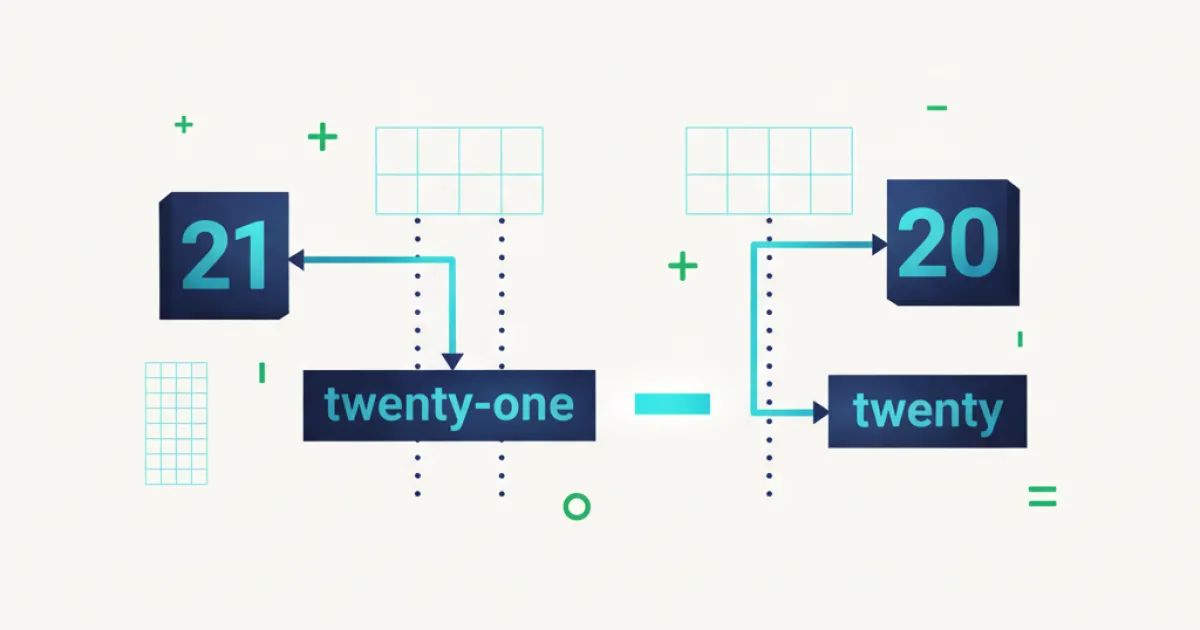
In English number words, you use a hyphen in compound numbers from twenty-one to ninety-nine when the number is not a multiple of ten. For example, 21 is written “twenty-one,” 35 is “thirty-five,” and 99 is “ninety-nine.” Larger numbers also keep the hyphen in the compound part, such as “one hundred twenty-one.” This rule helps ensure clarity and correctness when writing out numbers.
What is a Hyphen in Number Words?
A hyphen is a short line that joins parts of compound words. In number words, it connects the tens digit with the units digit to form a single numerical value. This indicates that words like "twenty" and "one" together represent one number, "21."
The Basic Rule: Twenty-One to Ninety-Nine
The main rule for hyphens in number words applies to compound numbers from 21 to 99, specifically those not ending in zero. When combining a tens word (e.g., "twenty," "thirty," "forty") with a units word (e.g., "one," "two," "three"), you typically place a hyphen between them.
- 21: twenty-one
- 35: thirty-five
- 48: forty-eight
- 99: ninety-nine
Numbers That Do Not Need Hyphens
Many numbers do not require hyphens:
- Single Digits (1-9): one, two, nine.
- Teens (11-19): eleven, fifteen, eighteen.
- Exact Multiples of Ten (20, 30, 40, etc.): These are single words.
Examples without hyphens:
- 20: twenty
- 30: thirty
- 40: forty (correct spelling)
- 90: ninety (correct spelling)
Hyphens in Larger Numbers
When writing larger numbers, the hyphenation rule for compound numbers from twenty-one to ninety-nine still applies within those specific parts. However, you do not hyphenate "hundred," "thousand," or "million" parts.
- 101: one hundred one
- 121: one hundred twenty-one (only "twenty-one" is hyphenated)
- 235: two hundred thirty-five (only "thirty-five" is hyphenated)
- 1,999: one thousand nine hundred ninety-nine (only "ninety-nine" is hyphenated)
Avoid hyphenating every word in a large number, such as "one-hundred-twenty-one," as this is not standard practice.
American vs. British English Number Words
The hyphenation rule for compound numbers like "twenty-one" is consistent in both American and British English. However, there's a common difference in using "and" in larger numbers:
- American English: Often omits "and" (e.g., "one hundred twenty-one").
- British English: Commonly includes "and" (e.g., "one hundred and twenty-one").
In both styles, the compound part "twenty-one" remains hyphenated.
Hyphen vs. Minus Sign: A Simple Distinction
A hyphen (-) joins words to form a compound (e.g., "twenty-one"). A minus sign (– or -) indicates subtraction (e.g., "8 – 5") or a negative value (e.g., "–5"). While visually similar, their functions are distinct. Do not confuse "twenty-one" with "twenty minus one."
Quick Reference Table
| Number | Correct Word Form | Wrong Form to Avoid | Explanation |
|---|---|---|---|
| 21 | twenty-one | twenty one | Compound number. |
| 30 | thirty | thirty- | Exact multiple of ten. |
| 35 | thirty-five | thirty five | Compound number. |
| 40 | forty | forty- / fourty | Exact ten, correct spelling. |
| 48 | forty-eight | forty eight | Compound number. |
| 76 | seventy-six | seventy six | Compound number. |
| 90 | ninety | ninety- / ninty | Exact ten, correct spelling. |
| 99 | ninety-nine | ninety nine | Compound number. |
| 101 | one hundred one | one-hundred-one | No hyphen for "hundred" or "one." |
| 121 | one hundred twenty-one | one-hundred-twenty-one | Hyphen only in "twenty-one." |
| 235 | two hundred thirty-five | two-hundred-thirty-five | Hyphen only in "thirty-five." |
| 1,999 | one thousand nine hundred ninety-nine | one-thousand-nine-hundred-ninety-nine | Hyphen only in "ninety-nine." |
Common Mistakes to Avoid
- Missing Hyphen: Writing "twenty one" instead of "twenty-one."
- Hyphenating Exact Tens: Adding a hyphen to "thirty" or "forty."
- Spelling Errors: Using "fourty" instead of "forty" or "ninty" instead of "ninety."
- Over-Hyphenation: Writing "one-hundred-twenty-one" instead of "one hundred twenty-one."
- Confusing Hyphen and Minus Sign: Using them interchangeably.
Practice Exercises
- Write 21 in words.
- Write 30 in words.
- Write 35 in words.
- Write 48 in words.
- Write 99 in words.
- Write 121 in words.
- Choose the correct form: “twenty one” or “twenty-one.”
- Explain why “one-hundred-twenty-one” is not the normal form.
Answers to Practice Exercises
- twenty-one: A compound number.
- thirty: An exact multiple of ten.
- thirty-five: A compound number.
- forty-eight: A compound number.
- ninety-nine: A compound number.
- one hundred twenty-one: "Twenty-one" is hyphenated.
- The correct form is “twenty-one.” It is a compound number.
- “one-hundred-twenty-one” is incorrect because only the compound tens-units part (e.g., "twenty-one") is hyphenated in larger numbers, not the "hundred" parts.
Continue Your Learning: Quizzes and Worksheets
Want more practice? Try a number words quiz or printable worksheet on Number-Digit.com to reinforce your knowledge and build confidence in writing numbers correctly.
Frequently Asked Questions (FAQs)
When do you hyphenate numbers in words? Generally, you hyphenate compound number words from twenty-one to ninety-nine, excluding exact multiples of ten. Is it “twenty one” or “twenty-one”? In standard English, it is "twenty-one" with a hyphen to join the compound parts. Do you hyphenate numbers over one hundred? Not for "hundred" or "thousand" parts. However, any compound number from twenty-one to ninety-nine within a larger number remains hyphenated (e.g., "one hundred twenty-one"). Is “one hundred twenty-one” hyphenated? Yes, the "twenty-one" part is hyphenated. The full number is written "one hundred twenty-one" (or "one hundred and twenty-one" in British English). Do exact tens like thirty and forty need hyphens? No, exact multiples of ten (twenty, thirty, forty, etc.) are written as single words without hyphens. Is a hyphen the same as a minus sign? No. A hyphen joins words (e.g., "twenty-one"), while a minus sign indicates subtraction or a negative value (e.g., "10 - 5").Practical Summary
For clear and correct English, hyphenate compound numbers from twenty-one to ninety-nine, but remember to omit hyphens for exact multiples of ten and for "hundred" or "thousand" parts of larger numbers. Mastering these rules will significantly improve your writing of number words.