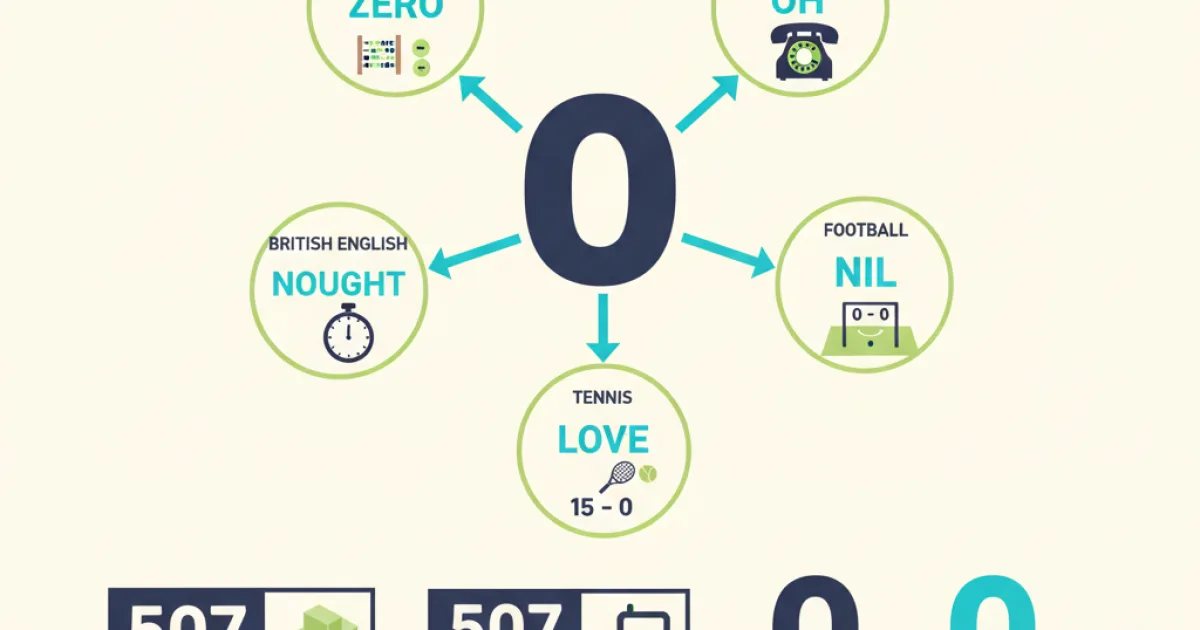
Quick Answer
“Zero” is the general name for 0, while “oh,” “nought,” “nil,” and “love” are used in particular contexts such as digit sequences, British English, sports scores, and tennis. For example, you might say “five oh seven” for a code, “nought point five” in British English, “two-nil” for a football score, or “fifteen-love” in tennis.
Why Does Zero Have Different Spoken Names?
English often uses different spoken forms for the digit 0 depending on the situation. While the numerical value of zero always stays the same, the context changes the conventional or commonly used word for it. This flexibility helps make communication clearer in various settings, from mathematics to sports scores and everyday digit sequences.
Key Rule
Use “zero” as the safe general name for 0. Use “oh,” “nought,” “nil,” or “love” only when the context commonly supports that reading.
When to Say “Zero”
“Zero” is the most common, general, and widely understood name for the number and digit 0. When in doubt, “zero” is almost always the clearest and safest choice. It's appropriate in ordinary mathematics, scientific contexts, and when reading numbers generally.
- Ordinary Mathematics: When 0 represents a numerical value in equations or calculations.
Example:
0 + 5 = 5is read as “zero plus five equals five.” - General Number Reading: When you refer to the number itself or its quantity. Example: “The temperature is zero degrees Celsius.”
When to Say “Oh”
The pronunciation “oh” is the spoken name of the letter O, but it is also commonly used for the digit 0 when digits are spoken individually in a sequence. This usage helps to quickly and clearly convey digit strings, especially in spoken communication.
- Phone Numbers: Many people say “oh” for 0 in phone numbers.
Example: A fictional phone number
555-0123might be read as “five five five oh one two three” or “five five five zero one two three.” Both are widely understood. - Codes and Room Numbers: In codes, serial numbers, or room numbers where digits are read one by one.
Example: A room number
507might be read as “five oh seven.” - Some Years: In certain years, particularly those in the early part of a century.
Example: The year
1905is often read as “nineteen oh five.”
It's important to remember that while “oh” is common in these contexts, “zero” is also often acceptable. The choice can depend on regional preference or individual speaking style.
Step-by-Step: Should 0 Be Read as Zero or Oh?
Consider the number 507:
- Look at the context: Is 507 being used as an ordinary whole number, or as a sequence of individual digits (like a room number or code)?
- If it's an ordinary whole number: Read it as “five hundred seven” (American English style) or “five hundred and seven” (British English style). Do not read it digit by digit.
- If it's a code or digit sequence: If you are reading it digit by digit, the middle 0 may be read as “zero” or “oh.”
- Possible digit-by-digit readings: For a code like 507, common readings include “five zero seven” or “five oh seven.”
- The context determines the natural reading: For an ordinary number, say “five hundred seven.” For a code, either “five zero seven” or “five oh seven” is usually fine, with “oh” being very common in casual speech.
When to Say “Nought”
“Nought” is a term for zero that is especially associated with British English. It can refer to the number zero itself or be used in specific numerical contexts.
- The Number Zero: In some British English contexts, “nought” can simply mean zero. Example: “The temperature dropped to nought degrees.”
- Decimal Readings: “Nought” is commonly used before a decimal point in British English.
Example:
0.5may be read as “nought point five.”
While “nought point five” is common in British English, “zero point five” is also widely understood and used, even in British English. “Zero” remains the more international and general term.
When to Say “Nil”
“Nil” is commonly used for a score of zero in certain sports, particularly in British English football (soccer) usage. It is not generally used as the normal word for zero in ordinary mathematics or everyday speech.
- Sports Scores: Especially in football/soccer.
Example: A score of
2–0(two to zero) in a football match is often read as “two-nil.”
Using “nil” outside of specific sports scoring contexts can sound unnatural or incorrect.
When Zero Is Called “Love”
In tennis scoring, “love” is the specific term used for a score of zero. This is a unique convention within the sport and does not apply to other contexts.
- Tennis Scores:
Example: A score of
15–0(fifteen to zero) in tennis is read as “fifteen-love.”
The term “love” for zero is strictly confined to tennis and similar scoring systems and should not be used as a general synonym for zero.
Digit 0 vs Letter O
It's crucial to distinguish between the digit 0 (zero) and the letter O (oh). While they can look very similar in some fonts and the digit 0 is often pronounced “oh” in certain sequences, they are different symbols with different meanings.
- 0 is a digit: It represents the numerical value of zero.
- O is a letter: It is part of the alphabet and forms words.
When you say “five oh seven” for a room number, the middle symbol is still the digit 0, not the letter O. This distinction is important for clarity, especially in contexts like codes or identifiers where confusing a digit with a letter could lead to errors.
Common Mistake
Wrong: Assuming 0 must always be pronounced “zero,” or that “oh” can replace “zero” everywhere.
Correct: “Zero” is the general term, while “oh” and other alternatives are context-dependent.
Why: The numeric value of 0 remains constant, but spoken English uses different forms in particular contexts to aid clarity or follow convention.
Comparison Table: Spoken Forms of Zero
| Context | Symbol or Example | Common Reading | Alternative or Note | What to Notice |
|---|---|---|---|---|
| Ordinary mathematics | 0 | zero | General form | Use “zero” as the safest general name. |
| Digit sequence | 507 | five zero seven / five oh seven | Depends on context | Do not confuse digit-by-digit reading with the whole number “five hundred seven.” |
| Phone number | 555-0123 | zero or oh | Depends on speaker/context | Both may occur; “oh” is very common in casual speech. |
| British-style decimal reading | 0.5 | nought point five | zero point five also possible | “Nought” is especially associated with British English. |
| Football/soccer score | 2–0 | two-nil | Sport and language variety matter | “Nil” is not the normal general mathematics word for zero. |
| Tennis score | 15–0 | fifteen-love | Tennis-specific usage | “Love” is context-specific and not used outside tennis. |
| Written symbol distinction | 0 and O | zero and the letter O | Different written symbols | Pronouncing 0 as “oh” does not turn it into the letter O. |
Common Mistakes to Avoid
- Overgeneralizing “Oh”: Do not assume “oh” can replace “zero” in all contexts, especially in formal mathematics.
- Confusing 0 and O: Remember that the digit 0 and the letter O are distinct symbols, even if they look alike and 0 is sometimes pronounced “oh.”
- Reading Whole Numbers Digit by Digit: An ordinary number like 507 should be read as “five hundred seven,” not “five oh seven,” unless it's specifically a code or sequence.
- Using “Nil” or “Love” Generally: These terms are specific to sports scores (football/soccer and tennis, respectively) and are not general synonyms for zero in other contexts.
- Assuming Uniform Usage: Be aware that language usage varies by region (e.g., British vs. American English) and individual preference.
Quick Practice
- What is the safest general spoken name for 0?
- In a digit sequence such as 507, what are two possible ways to read the middle 0?
- Which word for zero is especially associated with British English?
- How might a football score of 2–0 be read in British-style usage?
- What does “love” mean in a tennis score?
- Are the digit 0 and the letter O the same written symbol?
Answers
- The safest general spoken name for 0 is “zero.”
- In a digit sequence such as 507, the middle 0 can be read as “zero” or “oh.”
- “Nought” is especially associated with British English.
- A football score of 2–0 might be read as “two-nil” in British-style usage.
- In a tennis score, “love” means a score of zero.
- No, the digit 0 and the letter O are different written symbols.
FAQs
When should you say zero instead of oh?
You should generally say “zero” in ordinary mathematics, when referring to the numerical value, or when you want to be universally clear. “Zero” is the default and safest term for 0.
Why do people say oh instead of zero?
People often say “oh” instead of “zero” when reading digit sequences individually, such as in phone numbers, codes, or some years. This is a common convention that can make sequences easier to say and understand quickly, as “oh” is a single syllable and distinct.
Is it zero or oh in phone numbers?
In phone numbers, both “zero” and “oh” are commonly used for the digit 0. The choice often depends on the speaker's preference, regional dialect, or the specific context. Both pronunciations are widely understood.
What is the difference between zero and nought?
“Zero” is the general and internationally understood name for the number 0. “Nought” is a term for zero especially associated with British English, often used in contexts like decimal readings (“nought point five”) or when referring to the number itself in certain British contexts.
Why is zero called nil in football?
In football (soccer), zero is called “nil” as a specific scoring convention, particularly in British English. It's a traditional term used to indicate a score of zero goals for a team, like “two-nil,” and is not used for general mathematical zero.
Why is zero called love in tennis?
In tennis, zero is called “love” as a unique scoring term. The exact historical origin is debated, but it has become the established convention for indicating a score of zero points in a game, such as “fifteen-love.”
Is the digit 0 the same as the letter O?
No, the digit 0 and the letter O are not the same written symbol, although they can look very similar in many fonts. 0 represents a numerical value, while O is an alphabetical character. Pronouncing the digit 0 as “oh” in certain contexts does not change its identity as a digit.
Practical Summary
Understanding when to use “zero,” “oh,” “nought,” “nil,” or “love” for the digit 0 comes down to context. “Zero” is your safest and most general choice for the number 0. Use “oh” for individual digits in sequences like phone numbers or codes. “Nought” is common in British English, especially for decimals. “Nil” is reserved for certain sports scores, and “love” is specific to tennis. Always consider the situation to choose the most natural and appropriate term, and remember that the digit 0 is distinct from the letter O.