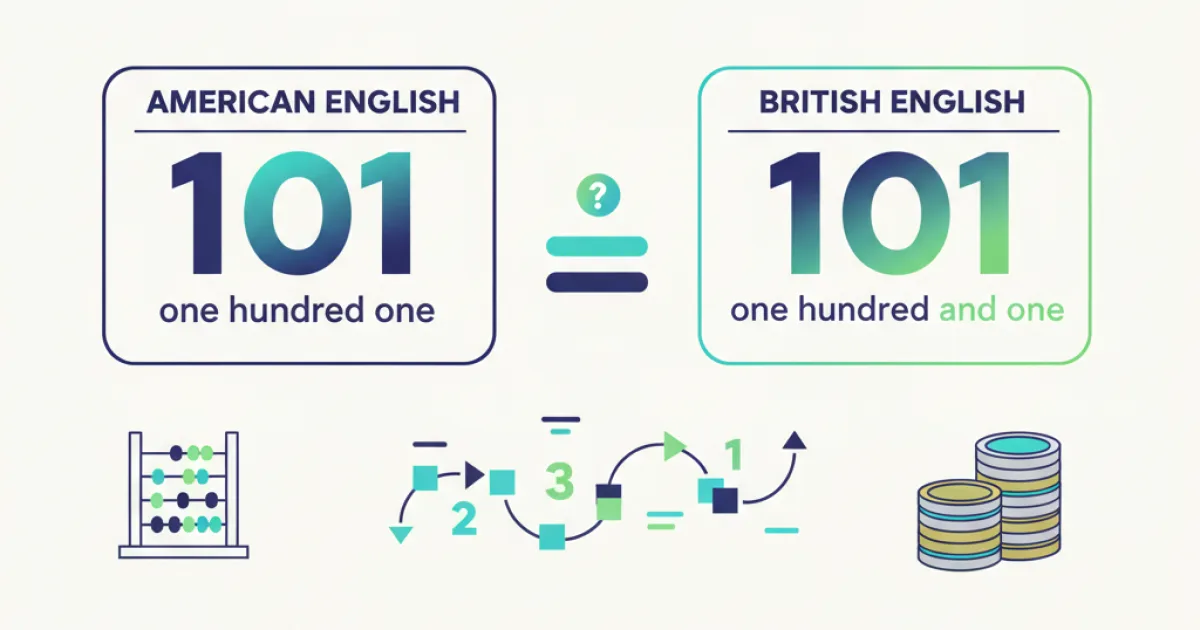
In American English, “and” is usually omitted when writing whole numbers in words, such as “one hundred one.” In British English, “and” is commonly included, as in “one hundred and one.” In both styles, “and” can help separate whole numbers from fractional parts, decimals, or different currency units within a single amount.
American English Usage for Whole Numbers
In American English, especially in formal writing and educational contexts, “and” is typically omitted in whole numbers. This convention helps to avoid confusion, particularly when dealing with decimals or mixed numbers where “and” might indicate the separation between the whole and fractional parts.
- Before tens and ones after hundreds: Omit “and.”Example: 101 → one hundred one (not “one hundred and one”)
- In larger numbers: “And” is generally not used within the whole number groups.Example: 1,105 → one thousand one hundred five
- In spoken language: While formal writing omits “and,” in casual American speech, you might occasionally hear “one hundred and one,” but it’s less common than in British English.
British English Usage for Whole Numbers
British English commonly includes “and” when writing whole numbers in words. This is a long-standing convention and is widely accepted in both formal and informal contexts.
- Before tens and ones after hundreds: “And” is commonly included.Example: 101 → one hundred and one
- In larger numbers: “And” is often used before the final tens or ones, or before the final part of a larger number.Example: 1,105 → one thousand one hundred and fiveExample: 2,015 → two thousand and fifteen
Decimals and Fractions
When it comes to numbers with decimal points or fractions, the use of “and” is more consistent across both American and British English, though with different common readings.
- Everyday decimal reading: For numbers like 3.5, the common everyday reading in both American and British English is typically using “point.”Example: 3.5 → three point five
- Formal fractional reading: When a decimal is read as a fraction, “and” is commonly used to separate the whole number from the fractional part.Example: 3.5 (as a fraction) → three and five tenths
- Mixed numbers: For mixed numbers like 3 ½, “and” is used to connect the whole number and the fraction.Example: 3 ½ → three and a half
Money Amounts
For money amounts, “and” is frequently used in both American and British English to clearly separate the main currency unit from its fractional component (cents, pence, etc.). This usage is particularly important for clarity in financial documents.
- Between dollars/pounds and cents/pence: “And” connects the whole currency amount to the fractional part.Example: $100.50 → one hundred dollars and fifty cents
- For clarity: This helps ensure there’s no ambiguity about where the whole amount ends and the fractional amount begins.
Comparison Table: “And” in Numbers
| Number or amount | American English | British English | Context |
|---|---|---|---|
| 101 | one hundred one | one hundred and one | Whole number |
| 125 | one hundred twenty-five | one hundred and twenty-five | Whole number |
| 1,105 | one thousand one hundred five | one thousand one hundred and five | Whole number |
| 1,100,005 | one million one hundred thousand five | one million one hundred thousand and five | Whole number |
| 3.5 | three point five (or three and five tenths) | three point five (or three and five tenths) | Decimal / Formal fraction |
| $100.50 | one hundred dollars and fifty cents | one hundred dollars and fifty cents | Money amount in dollars |
| £100.50 | one hundred pounds and fifty pence | one hundred pounds and fifty pence | Money amount in pounds |
Common Mistakes
One common mistake is incorrectly using “and” within whole numbers in American English, especially after “hundred.” For instance, writing “one hundred and two” when “one hundred two” is the preferred American style. Another error can be omitting “and” in money amounts or formal fractional readings where it adds clarity, regardless of dialect.
Practice Exercises
Write the following numbers in words, showing both American English and British English forms where relevant:
- 207
- 4,321
- 15.7
- €50.25
- 2,500,003
Answers to Practice Exercises
- 207
- American English: two hundred seven
- British English: two hundred and seven
- 4,321
- American English: four thousand three hundred twenty-one
- British English: four thousand three hundred and twenty-one
- 15.7
- Both: fifteen point seven (or fifteen and seven tenths)
- €50.25
- Both: fifty euros and twenty-five cents
- 2,500,003
- American English: two million five hundred thousand three
- British English: two million five hundred thousand and three
Frequently Asked Questions (FAQs)
1. Is “one hundred and one” wrong in American English?
While “one hundred one” is more common and often preferred in American English, saying “one hundred and one” is generally understood and not considered incorrect, especially in informal speech. However, in formal American writing, omitting “and” is usually the stylistic preference for whole numbers.
2. Should I use “and” when writing checks or money amounts?
Yes, for clarity, it is common practice in both American and British English to use “and” to separate the whole currency amount from the fractional part (cents or pence) when writing out checks or formal money amounts. For example, “one hundred dollars and fifty cents.”
3. Is “three and five tenths” the same as “three point five”?
Yes, “three and five tenths” and “three point five” refer to the same numerical value. “Three point five” is the common, everyday way to read the decimal 3.5. “Three and five tenths” is a more formal or fractional way of expressing the same decimal, indicating three whole units and five-tenths of another unit.
4. Does British English always use “and” in numbers?
British English commonly includes “and” before the tens and units (e.g., “one hundred and five”) and often in larger numbers before the final part (e.g., “two thousand and twenty”). While very common, it is a strong preference rather than an absolute rule that applies to every single numerical expression, but it is the default style for whole numbers after hundreds.
5. Which style should students use?
Students should generally follow the style guide or regional convention of their school or the specific context they are writing for. If they are in an American school, “one hundred one” is usually expected. In a British context, “one hundred and one” would be typical. Consistency within a single document is key.
Practical Summary
Understanding the use of “and” in numbers primarily boils down to recognizing the differences between American and British English conventions for whole numbers. While American English generally omits “and” in whole numbers, British English commonly includes it. For decimals, fractions, and money, “and” often plays a role in both dialects to signify separation between whole and fractional parts, enhancing clarity. Always consider your audience and the specific context when writing numbers in words.