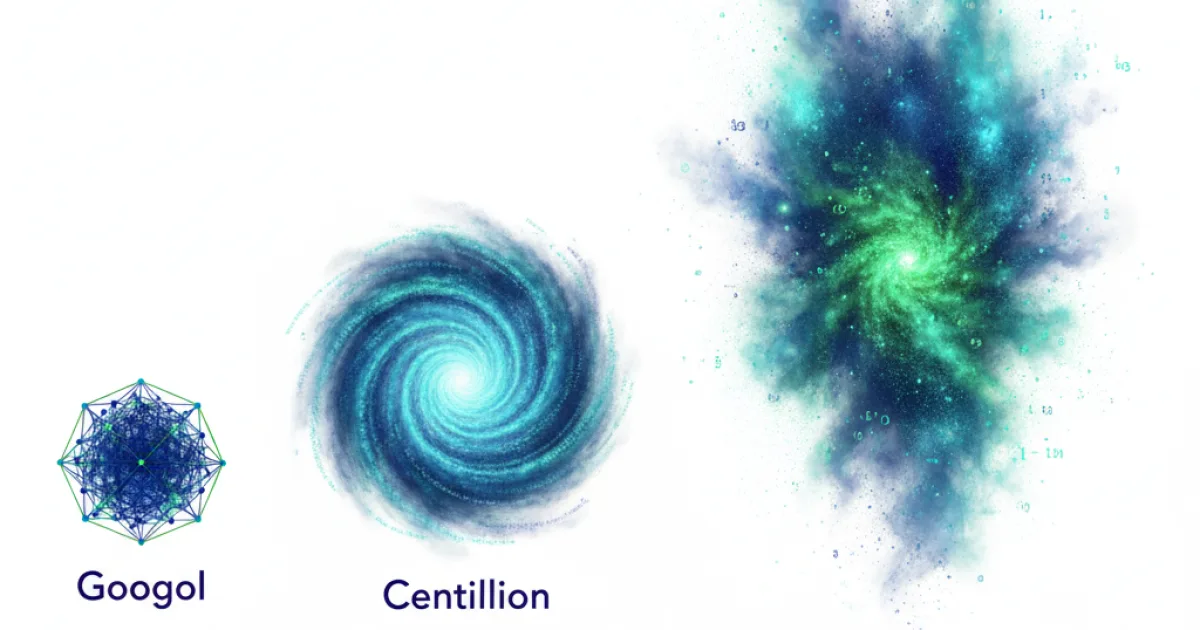
A googolplex is significantly bigger than both a centillion and a googol. In the short scale, a googol is defined as 10100 (1 followed by 100 zeros), a centillion is 10303 (1 followed by 303 zeros), and a googolplex is 10(10100). This means the definitive order from smallest to largest is: googol < centillion < googolplex.
What is a Googol?
A googol is a very large number, but it's often used as a starting point for understanding even bigger numbers. It was named in 1920 by nine-year-old Milton Sirotta, the nephew of American mathematician Edward Kasner. By definition, a googol is:
- 10100
- Which means 1 followed by 100 zeros.
To give you a sense of its scale, there are estimated to be around 1080 atoms in the observable universe. A googol is still much larger than that!
What is a Centillion?
The centillion is another extremely large number, but its exact value depends on the number-naming system being used: the short scale or the long scale. These systems are used in different parts of the world to name large numbers beyond a million.
- In the short scale: A centillion is 10303, which is 1 followed by 303 zeros. This system is commonly used in countries like the United States.
- In the long scale: A centillion is 10600, which is 1 followed by 600 zeros. This system is used in many European countries and elsewhere.
Regardless of the scale, a centillion is a number with hundreds of zeros.
What is a Googolplex?
If a googol is huge, a googolplex takes "huge" to an entirely different level. The definition of a googolplex is directly tied to the googol:
- It is 10googol
- Which means 10(10100)
- This translates to 1 followed by a googol zeros.
To clarify, "a googol zeros" means a number of zeros equal to 10100, not just 100 zeros. It is so astronomically large that it's impossible to write out all its zeros even if every atom in the universe were used as ink.
Which One Is Bigger? The Clear Ranking
Based on their definitions, the size comparison is unambiguous. The googolplex is the largest, followed by the centillion (in either scale), and then the googol.
Googolplex > Centillion > Googol
This hierarchy holds true because the centillion, even in its largest long-scale form (10600), has far fewer zeros than a googolplex, which has a googol (10100) zeros. And the centillion, with its hundreds of zeros, far surpasses the googol's mere 100 zeros.
Short Scale vs. Long Scale for Centillion
Understanding the difference between the short scale and long scale is important when discussing numbers like a centillion. These are simply two different systems for naming very large numbers:
- Short Scale: In this system, each new named number (like million, billion, trillion) usually increases by powers of 1,000. For example, a billion is a thousand millions (109). A centillion in this system is 10303.
- Long Scale: In this system, some large number names represent larger powers than in the short scale. For instance, a billion is a million millions (1012), and a 'milliard' is sometimes used for 109. A centillion in this system is 10600.
While the exact power of ten for a centillion differs significantly between these systems, the overall comparison with a googol and a googolplex remains consistent: a centillion is always between them in size.
Why Googolplex is Much Bigger Than Centillion
The difference in scale between a googolplex and a centillion is immense. A centillion, even in the long scale, has 600 zeros. A googolplex, by contrast, has a googol zeros. A googol itself is 1 followed by 100 zeros. So, a googolplex has 1 followed by 100 zeros worth of zeros. That's 10100 zeros! This number of zeros is vastly larger than the entire number of zeros in a centillion (which is 303 or 600). The magnitude is truly astronomical.
Comparison Table: Googol, Centillion, and Googolplex
| Number Name | Power of Ten | Zero Count | Size Compared with Others |
|---|---|---|---|
| Googol | 10100 | 100 zeros | Smallest of the three |
| Centillion (short scale) | 10303 | 303 zeros | Larger than googol, smaller than googolplex |
| Centillion (long scale) | 10600 | 600 zeros | Larger than googol, smaller than googolplex |
| Googolplex | 10(10100) | A googol zeros | Largest by an immense margin |
Common Mistakes When Comparing Large Numbers
- Confusing 100 zeros with a googol zeros: A googol has 100 zeros. A googolplex has a googol (10100) zeros. These are vastly different quantities.
- Thinking googol and googolplex are similar: While their names are similar, their sizes are not. A googolplex is unimaginably larger than a googol.
- Believing a googolplex is infinity: A googolplex is a finite, albeit incredibly large, number. Infinity is a concept representing endlessness, not a specific number.
- Forgetting short-scale and long-scale differences for centillion: The value of a centillion changes significantly depending on the naming system.
- Mixing up "Googol" and "Google": Googol is a number; Google is a technology company, whose name was inspired by the number googol.
- Comparing only names: Always compare the powers of ten or the number of zeros to understand the true magnitude.
- Misreading exponents: Be careful not to read 10(10100) as 10100. The exponent of a googolplex is a googol itself.
Quick Large Numbers Quiz
Test your understanding of these gigantic numbers!
- How many zeros are in a googol?
- In the short scale, how many zeros are in a centillion?
- Is a googolplex finite or infinite?
- Which is bigger: googol or centillion?
- Which is biggest: googol, centillion, or googolplex?
Want to test more large-number facts? Try the Large Numbers Quiz on Number-Digit.com.
Answers to Quick Large Numbers Quiz
- 100 zeros. A googol is 1 followed by 100 zeros (10100).
- 303 zeros. In the short scale, a centillion is 1 followed by 303 zeros (10303).
- Finite. A googolplex is an extremely large, but specific and finite, number.
- Centillion. A centillion (303 or 600 zeros) is significantly larger than a googol (100 zeros).
- Googolplex. The googolplex is vastly larger than both the centillion and the googol.
Frequently Asked Questions (FAQs)
1. Which is bigger, googol or centillion?
A centillion is bigger than a googol. A googol has 100 zeros, while a centillion has either 303 zeros (short scale) or 600 zeros (long scale), making it substantially larger.
2. Which is bigger, googol or googolplex?
A googolplex is immensely bigger than a googol. A googol is 10100, but a googolplex is 10googol, meaning it's 1 followed by a googol (10100) zeros.
3. Which is bigger, centillion or googolplex?
A googolplex is significantly bigger than a centillion. A centillion has hundreds of zeros (303 or 600), whereas a googolplex has a googol (10100) zeros, which is an incomparably larger quantity of zeros.
4. How many zeros are in a googol?
There are exactly 100 zeros in a googol. It is written as 1 followed by 100 zeros, or 10100.
5. How many zeros are in a centillion?
The number of zeros in a centillion depends on the naming system. In the short scale, a centillion has 303 zeros (10303). In the long scale, it has 600 zeros (10600).
6. Is a googolplex bigger than infinity?
No, a googolplex is not bigger than infinity. A googolplex is a finite number, albeit an extremely large one. Infinity is not a number in the conventional sense but a concept representing something without end or bound, so it cannot be compared in size to any finite number.
Practical Summary
When comparing these three colossal numbers, the hierarchy is clear: googolplex reigns supreme, followed by the centillion, and then the googol. A googol has 100 zeros. A centillion has either 303 or 600 zeros, depending on the naming system used. A googolplex, however, has an astounding googol number of zeros, placing it in a league of its own for sheer magnitude. Understanding these distinctions helps clarify the true scale of numbers that are far beyond everyday comprehension.