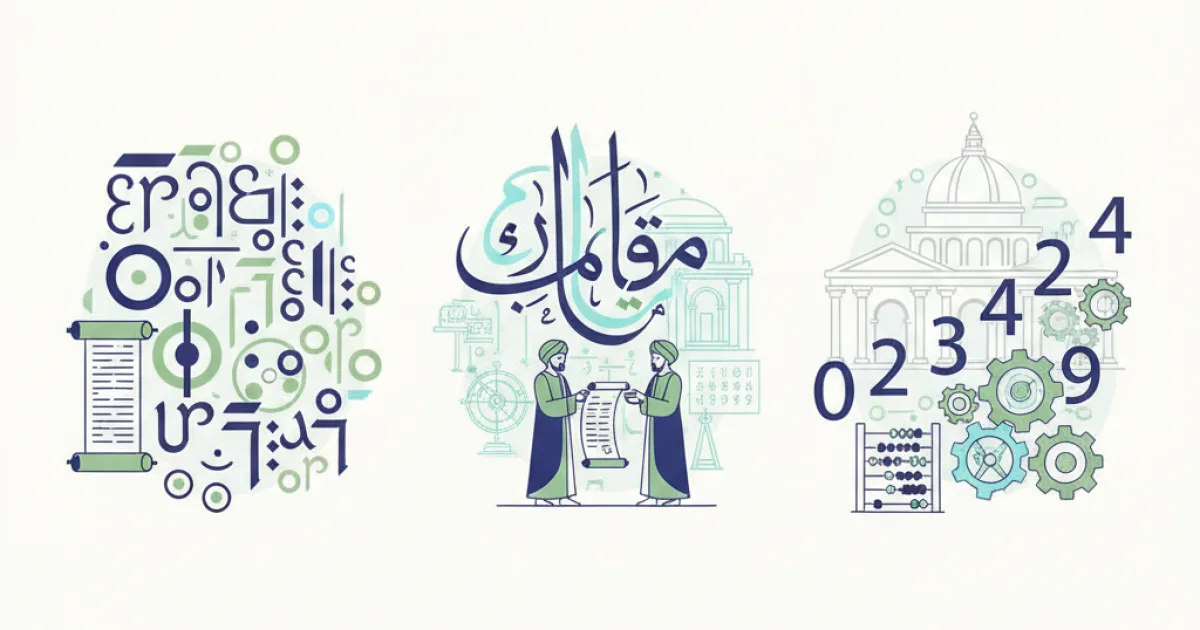
The digits 0–9 are commonly called Arabic numerals in English because Europeans learned and adopted this number system through Arabic-language mathematical texts. The system itself developed from Indian numerals, which is why it is more precisely called the Hindu-Arabic numeral system.
What Are Arabic Numerals?
In common English usage, "Arabic numerals" refers to the ten digits: 0, 1, 2, 3, 4, 5, 6, 7, 8, and 9. These are the symbols we use daily for counting, measuring, and calculations. This system is a positional numeral system, meaning the value of a digit depends on its position within a number (e.g., in "23", the '2' represents twenty, while in "32", it represents two).
Why Are They Called Arabic Numerals?
The name "Arabic numerals" acknowledges the crucial role of Arabic-speaking scholars in transmitting this number system to the Western world. While the fundamental concepts and the initial forms of these digits originated in ancient India, it was through the works of mathematicians and scholars in the Islamic Golden Age that this system was preserved, further developed, and spread across vast territories. European scholars later encountered and translated these Arabic texts, leading to the adoption of the system throughout Europe, where it eventually became known by the name of its immediate source of transmission.
It's important to understand that calling them "Arabic numerals" does not mean they were solely invented by Arab mathematicians. Instead, it highlights the historical pathway through which this powerful numerical tool reached a significant part of the world.
Why Hindu-Arabic Numerals Is a More Precise Name
To give credit to both the origin and the transmission, the term "Hindu-Arabic numeral system" is often considered more accurate. "Hindu" refers to the system's roots in ancient India, where the concept of zero (a placeholder digit) and the positional value system first emerged and were refined. "Arabic" acknowledges the vital role of Arab scholars in preserving, developing, and spreading these numerals, particularly to Europe.
This combined term better reflects the rich history and collaborative development of the number system we use today, recognizing contributions from different cultures over centuries.
Western Arabic Numerals vs. Eastern Arabic Digits
The term "Arabic numerals" can sometimes cause confusion because there are visually distinct forms of these digits. The digits we commonly use in English and much of the Western world are specifically called Western Arabic numerals:
0 1 2 3 4 5 6 7 8 9
However, many Arabic-speaking countries and other regions that use the Arabic script use a different set of symbols, known as Eastern Arabic digits (sometimes called Indic numerals in a modern context):
٠ ١ ٢ ٣ ٤ ٥ ٦ ٧ ٨ ٩
Both sets of digits represent the same numerical values and operate on the same Hindu-Arabic positional system, but their visual appearance differs. Western Arabic numerals are the familiar forms used in most printed and digital materials globally.
Arabic Numerals vs. Roman Numerals
To understand the significance of Arabic numerals, it's helpful to compare them with older systems, such as Roman numerals. Roman numerals use letters from the Latin alphabet to represent numbers:
I (1), V (5), X (10), L (50), C (100), D (500), M (1000)
One key difference is that Roman numerals are not a positional system in the same way. While there are rules for combining them (e.g., IV is 4, VI is 6), they lack a zero and a consistent positional value system. This makes complex calculations more challenging with Roman numerals compared to Arabic numerals.
For example, writing the year 2026:
- In Arabic numerals: 2026
- In Roman numerals: MMXXVI
The simplicity and efficiency of the Hindu-Arabic system for arithmetic quickly led to its widespread adoption over Roman numerals, especially as trade and science advanced.
Why the Name Can Be Confusing
The name "Arabic numerals" can be confusing for several reasons:
- It doesn't immediately suggest the system's Indian origins.
- It can be mistaken to imply that the digits were invented solely by Arabs.
- It doesn't distinguish between the Western forms (0-9) and the Eastern forms (٠-٩) without further clarification.
Understanding the full historical context helps clarify why this naming convention is used in English and why "Hindu-Arabic" offers a more complete picture.
Comparison Table
| System | Example | Common use | What to notice |
|---|---|---|---|
| Western Arabic numerals | 0 1 2 3 4 5 6 7 8 9 | Most of the world, especially in English-speaking contexts, mathematics, science. | The familiar digits used globally; derived from the Hindu-Arabic system. |
| Eastern Arabic digits | ٠ ١ ٢ ٣ ٤ ٥ ٦ ٧ ٨ ٩ | Many Arabic-speaking countries, Iran, Pakistan, Afghanistan, parts of India. | Visually different from Western Arabic numerals but represent the same values. |
| Roman numerals | I, V, X, L, C, D, M | Clocks, chapter numbers, monarch names, some dates in formal contexts. | Uses letters; lacks a zero; not a positional system in the same way. |
| Hindu-Arabic numeral system | Uses 0-9 (or ٠-٩) | The underlying mathematical system for both Western and Eastern digits. | Refers to the entire positional system with zero, originating in India and transmitted by Arabs. |
Common Mistakes
- Believing Arabs invented zero: While Arab scholars refined and transmitted the concept, the idea of zero as a placeholder originated in India.
- Confusing Western and Eastern forms: Assuming "Arabic numerals" always refers to the exact visual forms of 0-9, overlooking the distinct Eastern Arabic digits.
- Thinking Roman numerals are a type of Arabic numeral: These are entirely separate numeral systems with different origins and operational principles.
Practice Questions
- Are 1, 2, and 3 Arabic numerals in English usage?
- What is a more precise name for the full system of 0–9 digits?
- Which system uses symbols such as I, V, and X?
- What is the difference between Western Arabic numerals and Eastern Arabic digits?
Answers to Practice Questions
- Yes, in English usage, 1, 2, and 3 are indeed Arabic numerals, referring to the common Western forms.
- A more precise name for the full system of 0–9 digits, acknowledging its origins and transmission, is the Hindu-Arabic numeral system.
- The system that uses symbols such as I, V, and X is the Roman numeral system.
- Western Arabic numerals are the familiar digits 0 1 2 3 4 5 6 7 8 9, used widely in English and globally. Eastern Arabic digits are visually different forms, such as ٠ ١ ٢ ٣ ٤ ٥ ٦ ٧ ٨ ٩, used in many Arabic-script contexts.
Frequently Asked Questions (FAQs)
1. Are 123 Arabic numerals?
Yes, in common English usage, the digits 1, 2, and 3 are considered Arabic numerals. More broadly, the entire number "123" is written using Arabic numerals, specifically the Western Arabic forms.
2. Why are they called Arabic numerals if they came from India?
They are called Arabic numerals in English because Europeans adopted this number system through Arabic mathematical texts. The system itself originated in India, and Arabic scholars played a crucial role in its development, preservation, and transmission to the West.
3. What are Hindu-Arabic numerals?
Hindu-Arabic numerals refer to the complete numeral system, including the digits 0-9 (in both Western and Eastern forms), and the positional value concept, which originated in India and was transmitted by Arabic scholars. It's considered a more precise name to acknowledge both origins.
4. Are Arabic numerals the same as Roman numerals?
No, Arabic numerals and Roman numerals are distinct number systems. Arabic numerals (0-9) are a positional system with a concept of zero, making calculations efficient. Roman numerals (I, V, X, etc.) use letters and operate on different principles, without a zero or the same positional value.
5. What is the difference between Western Arabic and Eastern Arabic digits?
Western Arabic digits are the familiar forms 0 1 2 3 4 5 6 7 8 9, used in most of the world. Eastern Arabic digits are visually different symbols, such as ٠ ١ ٢ ٣ ٤ ٥ ٦ ٧ ٨ ٩, used in many regions that employ the Arabic script. Both represent the same numerical values within the Hindu-Arabic system.
Summary: Understanding Our Numbers
The digits we use every day, 0 through 9, are commonly known as Arabic numerals due to their historical transmission to Europe via Arabic scholarship. While their fundamental concepts and initial forms developed in India, the term "Hindu-Arabic numerals" offers a more complete description of their rich history. Recognizing the distinction between Western Arabic numerals and Eastern Arabic digits, and understanding their efficiency compared to systems like Roman numerals, helps clarify the journey of these essential mathematical tools.