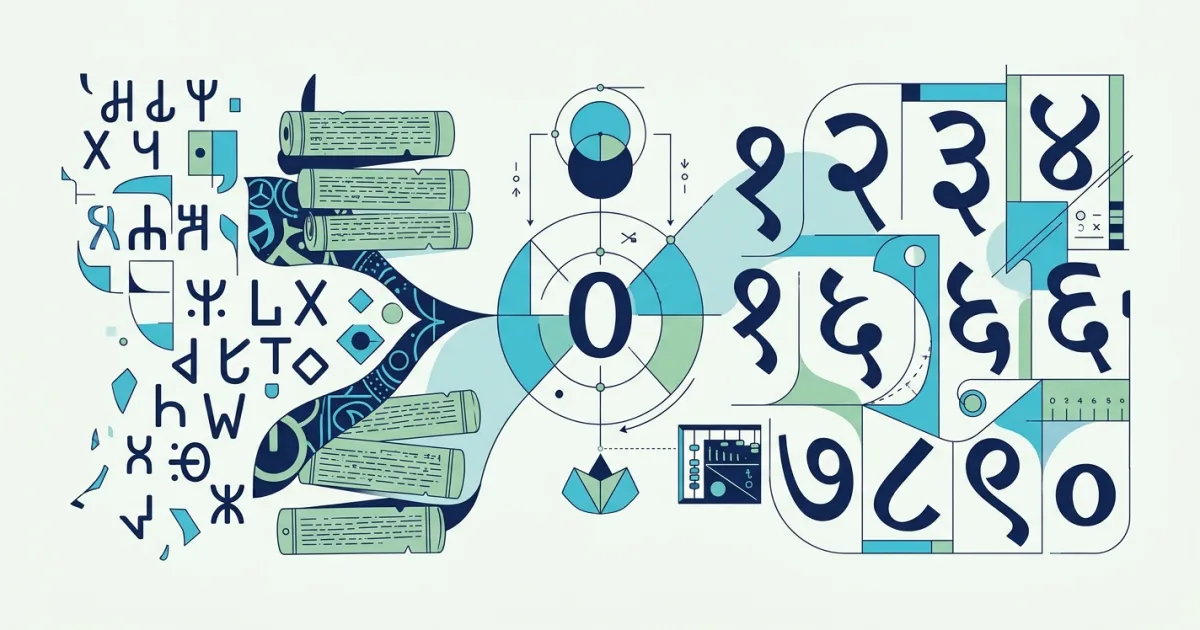
Devanagari numerals (० १ २ ३ ४ ५ ६ ७ ८ ९) are the traditional digit symbols written in the Devanagari script. These symbols are deeply connected to Indian mathematical history, the development of place value, and the global story of how modern numbers came to be. Understanding these digits helps language learners, students, and history enthusiasts see the direct connection between ancient mathematical traditions and the numbers we use worldwide today.
Quick Answer: What Are Devanagari Numerals?
Devanagari numerals are the ten decimal digits used within the Devanagari writing system. They represent the exact same values as the Western Arabic numerals (0 to 9) and function under the same base-10 decimal system. Today, they are primarily used in languages such as Hindi, Sanskrit, Marathi, Nepali, and Konkani. They belong to a vast family of Indian numeral traditions that eventually traveled westward, shaping the modern global system of counting.
Devanagari Numerals 0 to 9
To understand how these numbers function, it is helpful to look at their shapes alongside their Western counterparts. The table below lists each Devanagari digit, its Western equivalent, its numerical value, and a common example of its use.
| Western Digit | Devanagari Digit | Value | Example of Use |
|---|---|---|---|
| 0 | ० | Zero | १० (Ten) |
| 1 | १ | One | १५ (Fifteen) |
| 2 | २ | Two | २५ (Twenty-Five) |
| 3 | ३ | Three | ३० (Thirty) |
| 4 | ४ | Four | ४२ (Forty-Two) |
| 5 | ५ | Five | ५० (Fifty) |
| 6 | ६ | Six | ६४ (Sixty-Four) |
| 7 | ७ | Seven | ७५ (Seventy-Five) |
| 8 | ८ | Eight | ८८ (Eighty-Eight) |
| 9 | ९ | Nine | ९९ (Ninety-Nine) |
When these digits are combined, they follow the standard decimal place-value rules. For example:
- १० represents 10
- २५ represents 25
- १०८ represents 108
- २०२६ represents 2026
Why Devanagari Numerals Matter in Number History
Numerals are more than just simple marks on paper; they are the tools civilizations use to record transactions, construct architecture, calculate astronomical movements, and pass down knowledge. The development of Devanagari numerals is a key chapter in the global history of numbers. Without the decimal place-value system preserved and refined in Indian mathematical texts, modern science, commerce, and digital technology would look entirely different. These symbols show us how local cultural writing systems carried universal mathematical truths across centuries.
Historical Background: From Brahmi to Devanagari
The story of Devanagari numerals did not begin in a single year or with a single inventor. Instead, it is a story of gradual evolution over thousands of years. Scholars trace the roots of these symbols back to the Brahmi numerals, which were used in ancient India around the 3rd century BCE.
Early Brahmi numerals did not use a decimal place-value system with a zero. Instead, they had separate symbols for numbers like ten, twenty, one hundred, and one thousand. Over many centuries, Indian mathematicians realized that they could represent any number, no matter how large, using only ten symbols if the position of the symbol determined its value. This transition to the decimal place-value system occurred gradually during the mid-first millennium CE.
As scripts in the Indian subcontinent evolved, the Brahmi characters transformed into Gupta script, Sharada script, and eventually the Devanagari script by the 11th century CE. The numeral shapes evolved alongside the letters, resulting in the elegant curves of the modern Devanagari digits we see today.
The Role of Zero in Devanagari Numerals
One of the most significant contributions of Indian mathematics is the formalization of zero as both a placeholder and a standalone number. In the Devanagari system, zero is represented by a small circle: ० (known as shunya in Sanskrit, meaning void or empty).
The inclusion of the Devanagari zero allowed for the creation of an elegant, infinite counting system. Without the ०, writing numbers like ten (१०), one hundred (१००), or one thousand (१०००) would require unique, complex symbols for each power of ten. The placeholder zero simplified arithmetic, making multiplication, division, and complex algebra accessible to students and merchants alike.
Devanagari Numerals and the Hindu-Arabic Numeral System
The international system of numbers used globally today is known as the Hindu-Arabic numeral system. This name reflects its historical journey: developed by Indian mathematicians, adopted and refined by Arab scholars, and eventually introduced to Europe during the Middle Ages.
While Western Arabic numerals (0, 1, 2, 3...) and Devanagari numerals (०, १, २, ३...) look quite different today, they share a common ancestor. They are different visual representations of the same underlying mathematical logic. The table below compares Western Arabic digits, Devanagari digits, and Eastern Arabic digits to show their structural relationships.
| Value | Western Arabic Numerals | Devanagari Numerals | Eastern Arabic / Arabic-Indic Numerals |
|---|---|---|---|
| 0 | 0 | ० | ٠ |
| 1 | 1 | १ | ١ |
| 2 | 2 | २ | ٢ |
| 3 | 3 | ३ | ٣ |
| 4 | 4 | ४ | ٤ |
| 5 | 5 | ५ | ٥ |
| 6 | 6 | ६ | ٦ |
| 7 | 7 | ७ | ٧ |
| 8 | 8 | ८ | ٨ |
| 9 | 9 | ९ | ٩ |
For a deeper look at the western branch of this family tree, you can read our comprehensive guide on Arabic numerals.
Where Are Devanagari Numerals Used Today?
Devanagari numerals remain active and vital in modern communication. They are widely used in:
- Sanskrit Texts: Classical scriptures, philosophical treatises, and historical documents.
- Hindi Literature: Traditional books, calendars, poetry collections, and academic resources.
- Marathi and Nepali Contexts: Official documents, signboards, newspapers, and school textbooks.
- Cultural Materials: Indian festival calendars, religious charts, and traditional astronomical systems.
While Western Arabic numerals are increasingly common in modern Indian business, technology, and daily life, Devanagari digits remain a crucial symbol of cultural identity and linguistic heritage.
Devanagari Numerals in Unicode and Digital Text
In the digital age, Devanagari digits are encoded as unique text characters rather than static images. This allows computers, smartphones, and search engines to read, sort, and process them seamlessly. The Unicode Consortium assigns a specific code point to each Devanagari digit within the Devanagari block (U+0900 to U+097F).
| Digit | Unicode Name | Code Point |
|---|---|---|
| ० | DEVANAGARI DIGIT ZERO | U+0966 |
| १ | DEVANAGARI DIGIT ONE | U+0967 |
| २ | DEVANAGARI DIGIT TWO | U+0968 |
| ३ | DEVANAGARI DIGIT THREE | U+0969 |
| ४ | DEVANAGARI DIGIT FOUR | U+096A |
| ५ | DEVANAGARI DIGIT FIVE | U+096B |
| ६ | DEVANAGARI DIGIT SIX | U+096C |
| ७ | DEVANAGARI DIGIT SEVEN | U+096D |
| ८ | DEVANAGARI DIGIT EIGHT | U+096E |
| ९ | DEVANAGARI DIGIT NINE | U+096F |
Devanagari Numerals vs Western Arabic Numerals
The primary difference between Devanagari and Western Arabic numerals lies in their visual shapes (glyphs). The underlying mathematical value, the base-10 structure, and the place-value rules are identical.
For example, the value of the year 2026 is written as २०२६ in Devanagari. It still consists of two thousands, zero hundreds, two tens, and six ones. Similarly, the number fifteen is written as १५, and one thousand is written as १००० (or १,००० with formatting commas). Because the system is identical in logic, converting between the two styles is straightforward for students.
Devanagari Numerals and the Indian Number System
It is important to distinguish between the numeral symbols (the digits) and the numerical grouping system. While Western countries group large numbers by thousands (millions, billions), the traditional Indian number system groups numbers by lakhs and crores.
When writing large numbers with Devanagari digits, the Indian grouping style is typically used:
- १,००,००० represents 1,00,000 (One Lakh, which is equal to 100,000).
- १,००,००,००० represents 1,00,00,000 (One Crore, which is equal to 10,000,000).
Understanding this distinction helps students avoid confusion when reading financial documents or historical texts from South Asia.
Common Misconceptions About Devanagari Numerals
- "Devanagari numerals are a completely different mathematical system."This is incorrect. They use the exact same base-10 decimal place-value logic as Western numerals. Only the visual shapes of the digits are different.
- "Devanagari numerals are identical to Arabic numerals."While they share a historical lineage, they are visually distinct. Western Arabic numerals evolved in Europe after traveling through North Africa, while Devanagari digits developed directly within India.
- "Devanagari numerals are only used in Hindi."Devanagari is a script, not a language. It is used to write Sanskrit, Marathi, Nepali, Sherpa, and several other languages, all of which utilize these same digits.
- "Devanagari digits are just images on websites."They are fully standardized Unicode text characters that can be searched, copied, and indexed by search engines.
- "All Indian scripts use these exact same numeral shapes."India has many distinct writing systems. Scripts like Bengali, Tamil, Gujarati, and Telugu have their own unique historical digit shapes, though they all share common historical roots.
Interesting Facts About Devanagari Numerals
- The digit zero (०) is directly derived from the Sanskrit word shunya, which means void.
- Devanagari numerals can express any real number, including decimals and fractions, using the exact same formatting rules as Western mathematics.
- The curves of the digit ३ (three) and ७ (seven) bear a striking resemblance to their Western counterparts, showing their shared evolutionary lineage.
- Unicode integration ensures that Devanagari digits are fully supported across all modern operating systems and web browsers.
Student-Friendly Examples
Let us look at some simple conversions to practice identifying these digits:
- ५ = 5 (Five)
- १२ = 12 (Twelve)
- ३० = 30 (Thirty)
- १०८ = 108 (One Hundred and Eight)
- २०२६ = 2026 (Two Thousand Twenty-Six)
- १,००,००० = 1,00,000 (One Lakh / One Hundred Thousand)
Classroom and Teaching Ideas
Teachers can introduce these historical digits to students using these simple activities:
- Matching Game: Create flashcards with Devanagari digits on one side and Western Arabic digits on the other. Have students match them up.
- Write the Year: Ask students to write their birth year or the current calendar year using Devanagari digits.
- Place-Value Chart: Use a standard place-value chart (Ones, Tens, Hundreds) but have students fill in the columns using Devanagari symbols.
- Compare the Scripts: Show students a side-by-side comparison of Western, Eastern Arabic, and Devanagari digits to trace how the shapes changed over time.
Mini Practice Quiz
Test your understanding of Devanagari digits with this quick quiz. Try to answer the questions before checking the key below.
- What Western value does the digit ५ represent?
- How do you write the number 2026 using Devanagari digits?
- What is the Devanagari symbol for zero?
- Is the number १०८ equal to 18 or 108?
- Which Western digit corresponds to the symbol ७?
- What does १,००,००० represent in the Indian number system?
- Are Devanagari digits stored as images or text characters in modern computers?
- Name two languages other than Hindi that use the Devanagari script.
Answer Key
- 5
- २०२६
- ०
- 108
- 7
- One Lakh (100,000)
- Text characters (Unicode)
- Sanskrit, Marathi, or Nepali
Related Number-Digit.com Pages
To continue your journey into the world of numbers, explore these helpful resources on our site:
- Learn more about the global development of counting systems on our Number History and Facts hub.
- Explore how Indian numbers are grouped and read with our guide to the Indian Number System.
- Discover how to write large values in words using our Number to Words converter.
- Find educational materials and exercises on our Worksheets page.
- Test your mathematical knowledge with our collection of interactive Quizzes.
Frequently Asked Questions
What are Devanagari numerals?
Devanagari numerals are the set of ten digit symbols (० १ २ ३ ४ ५ ६ ७ ८ ९) used in the Devanagari script to represent numbers from 0 to 9 in a decimal place-value system.
What are the Devanagari digits from 0 to 9?
The digits are: ० (0), १ (1), २ (2), ३ (3), ४ (4), ५ (5), ६ (6), ७ (7), ८ (8), and ९ (9).
Are Devanagari numerals still used today?
Yes, they are actively used in India and Nepal for literature, official documents, calendars, religious texts, and educational materials, though Western Arabic numerals are also widely used in daily commerce.
Which languages use Devanagari numerals?
Languages written in the Devanagari script use these numerals. This includes Hindi, Sanskrit, Marathi, Nepali, Maithili, and Konkani.
Are Devanagari numerals the same as Hindi numerals?
Yes. Because Hindi is written in the Devanagari script, these digits are frequently referred to as Hindi numerals in everyday language.
Are Devanagari numerals the same as Arabic numerals?
No, they are not the same visually, but they are closely related. Both systems evolved from ancient Indian Brahmi numerals and share the same decimal place-value logic.
What is zero in Devanagari numerals?
Zero is represented by a small circular symbol: ०. It is historically linked to the Sanskrit concept of shunya.
How do you write 2026 in Devanagari numerals?
The year 2026 is written as २०२६.
Are Devanagari digits Unicode characters?
Yes, they are fully standardized Unicode characters located in the Devanagari block, spanning code points U+0966 to U+096F.
How are Devanagari numerals connected to Indian number history?
They represent the direct evolution of the ancient Brahmi numeral system and the early decimal place-value framework developed by Indian mathematicians like Aryabhata and Brahmagupta.
In summary, Devanagari numerals are a beautiful and historically significant set of symbols. They remind us of the shared global heritage of mathematics, connecting ancient Indian scholarship with the modern digital devices we use every day.