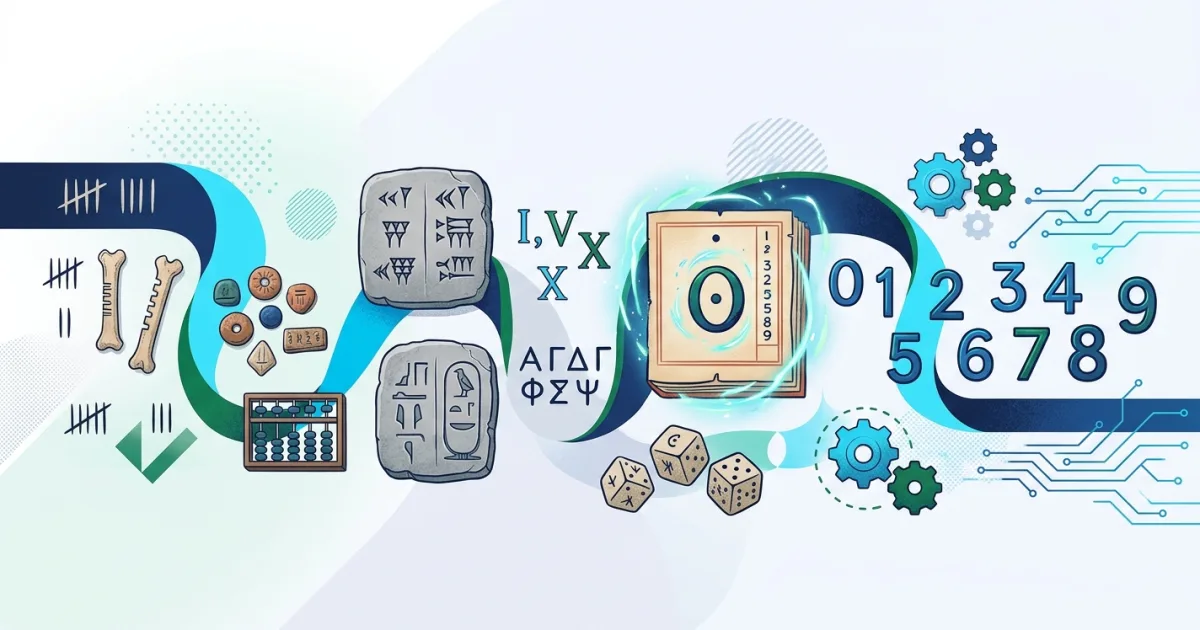
Numbers feel completely natural to us today, but they are actually the result of thousands of years of human development. Long before anyone wrote down a digit like "5" or "9," early humans had to find ways to track their belongings, count their animals, measure time, and trade with their neighbors. The journey from basic counting marks on bone to the modern digital systems we use on our computers is one of the most important stories in human history.
Quick Answer: What Is the History of Numbers?
The history of numbers is the gradual process of how humans learned to count, record quantities, create written symbols, and build efficient mathematical systems. This evolutionary journey began with simple tally marks and physical objects, progressed to complex regional numeral systems, and eventually culminated in the global adoption of the decimal place-value system with the invention of zero.
This long historical journey includes several key stages:
- Early counting using fingers, stones, and notched bones.
- The creation of simple tally marks and repetitive symbols.
- The development of ancient numeral systems by the Egyptians, Babylonians, Romans, and Mayans.
- The breakthrough of place-value systems and the mathematical definition of zero.
- The spread of the Hindu-Arabic decimal system, which forms the basis of modern mathematics.
Why Did Humans Need Numbers?
As early human societies grew, survival required more than just recognizing the difference between "one" and "many." People needed precise ways to record and communicate quantities. Several practical needs drove the development of numbers:
- Agriculture and Livestock: Farmers needed to count their sheep, cattle, and crops to manage their resources and plan for winter.
- Trade and Commerce: Merchants needed a reliable way to barter goods, calculate values, and record debts.
- Timekeeping and Astronomy: Ancient civilizations tracked the phases of the moon, seasons, and solar cycles to know when to plant and harvest crops.
- Construction and Measurement: Building shelters, temples, and canals required precise measurements of length, width, and volume.
- Administration and Taxation: Early rulers and governments needed to count populations and collect taxes to maintain cities and empires.
For example, a trader in ancient Mesopotamia could not rely on memory alone to track hundreds of jars of olive oil. They needed a permanent, written record that anyone could understand.
Before Written Numbers: Counting with Objects and Marks
Before civilizations developed writing, humans used physical objects to count. Fingers were the most convenient tool, which is why most cultures eventually developed base-10 systems. When fingers were not enough, people used pebbles, shells, twigs, or clay tokens.
Another early method was the use of tally marks carved into wood, stone, or bone. Archaeologists have discovered ancient animal bones with carved notches, such as the Ishango bone found in Africa. While some historians suggest these marks represent early counting or calendar records, others caution that we cannot know their exact purpose with absolute certainty. What we do know is that tallying provided a simple, physical way to keep track of quantities one by one.
Tally Marks and the First Simple Numeral Systems
Tally marks are the simplest form of written numbers. Each mark represents one unit:
- I = 1
- II = 2
- III = 3
- IIII = 4
While tally marks are highly intuitive for small quantities, they become incredibly inefficient for larger numbers. Imagine trying to write the number 542 using only single tally marks. It would take a long time to write, cover a massive space, and be nearly impossible to read quickly without making a mistake. This limitation forced ancient societies to invent more advanced ancient numeral systems.
Ancient Numeral Systems
Different cultures around the world developed unique ways to write numbers. Each system contributed something valuable to the evolution of mathematics.
Egyptian Numerals
The ancient Egyptians developed a decimal system (base-10) around 3000 BCE. Instead of using place value, they used specific hieroglyphic symbols for powers of ten, such as a single stroke for 1, a heel bone for 10, a coil of rope for 100, and a lotus flower for 1,000. To write a number, they repeated these symbols as many times as needed. While this made it possible to write large numbers, it still required a lot of repetitive drawing.
Babylonian Numbers
The Babylonians, living in Mesopotamia, developed a sexagesimal (base-60) system around 2000 BCE. They used wedge-shaped marks (cuneiform) pressed into wet clay tablets. Interestingly, the Babylonian system was one of the earliest to use a positional (place-value) concept, meaning the value of a symbol depended on its position in the number. We still see the legacy of this base-60 system today in how we divide an hour into 60 minutes and a circle into 360 degrees.
Roman Numerals
Developed in ancient Rome, Roman numerals used letters from the Latin alphabet to represent values: I (1), V (5), X (10), L (50), C (100), D (500), and M (1,000). This system relies on addition and subtraction rules (for example, IV is 4, while VI is 6). Although Roman numerals are highly stylized and still used today on clock faces, book chapters, and monuments, they are extremely difficult to use for complex arithmetic like multiplication and division.
Mayan Numerals
The Mayan civilization of Central America developed a highly sophisticated vigesimal (base-20) system. They used only three basic symbols: dots for units of one, horizontal bars for units of five, and a shell-like symbol to represent a placeholder or zero. Their system was written vertically and was closely tied to their incredibly accurate calendar calculations.
The Big Breakthrough: Place Value
The greatest leap forward in the history of numbers was the development of place value. In a place-value system, the position of a digit determines its actual value. For example, in the number 555, each "5" represents a completely different value:
- The rightmost 5 represents 5 units (5).
- The middle 5 represents 5 tens (50).
- The leftmost 5 represents 5 hundreds (500).
Before place value, writing large numbers required inventing new symbols or repeating old ones endlessly. Place value allowed humans to write any number, no matter how large, using only a small, fixed set of symbols. This breakthrough made basic arithmetic much easier to perform and teach.
The Invention and Importance of Zero
Place value cannot work efficiently without a symbol for nothing: zero. Without zero, it is difficult to distinguish between the numbers 15, 105, and 1,500 when writing them down quickly.
The concept of zero developed gradually in stages. Many ancient cultures used empty spaces or small placeholder marks to show that a position was empty. However, treating zero as an actual number with its own mathematical rules was a revolutionary step. Indian mathematicians, including Brahmagupta in the 7th century CE, played a monumental role in defining zero as a number that could be added, subtracted, and multiplied. This development transformed mathematics from a tool for simple counting into a powerful system for advanced algebra.
Hindu-Arabic Numerals and the Modern Digits
The numbers we use today (0, 1, 2, 3, 4, 5, 6, 7, 8, 9) are known as Hindu-Arabic numerals. This decimal system was originally developed by Indian mathematicians and is closely linked to Devanagari numerals and the Indian number system.
During the Golden Age of Islam, Persian and Arabic scholars translated Indian mathematical texts. Scholars like Al-Khwarizmi wrote influential books explaining how to use this efficient system for calculation. Italian mathematician Fibonacci later introduced these "Arabic" numerals to Europe in the early 13th century through his book Liber Abaci. European merchants quickly realized that this system made bookkeeping and trade far easier than using Roman numerals.
Comparing Numeral Systems
To understand why the Hindu-Arabic system became the global standard, it is helpful to compare it directly with the Roman numeral system:
| Feature | Roman Numerals | Hindu-Arabic Numerals |
|---|---|---|
| Main Symbols | I, V, X, L, C, D, M | 0, 1, 2, 3, 4, 5, 6, 7, 8, 9 |
| Base System | Base 10 (without positional value) | Base 10 (decimal) |
| Place Value | No (uses additive/subtractive rules) | Yes (value depends on position) |
| Concept of Zero | No symbol or value for zero | Yes (0 acts as placeholder and number) |
| Arithmetic Ease | Difficult for long calculations | Very easy for all calculations |
| Modern Use | Traditional, decorative, formal names | Universal standard for science and daily life |
Timeline of Number History
The evolution of numbers did not happen overnight. It was a gradual process spanning thousands of years and multiple continents.
| Approximate Period | Historical Development | Why It Mattered |
|---|---|---|
| Prehistory | Tally marks and physical counting tokens | Allowed humans to keep basic records of physical goods. |
| c. 3000 BCE | Egyptian hieroglyphic numerals | Introduced organized symbols for powers of ten. |
| c. 2000 BCE | Babylonian base-60 cuneiform | Introduced early positional notation; still influences timekeeping. |
| c. 500 BCE | Development of Roman numerals | Created a standardized system used across Europe for centuries. |
| c. 500 CE | Indian mathematicians refine place value and zero | Laid the foundation for modern arithmetic and algebra. |
| c. 800 CE | Spread of numerals to the Islamic world | Preserved, expanded, and standardized mathematical knowledge. |
| c. 1202 CE | Fibonacci introduces the system to Europe | Revolutionized European commerce, science, and education. |
| Modern Era | Global standardization and binary computing | Powers global technology, internet communications, and science. |
Common Misconceptions About the History of Numbers
Because the history of mathematics is so vast, several common myths have persisted over time:
- Myth: "Arabic numerals" were invented solely in Arab countries. In reality, the system originated in India. Arabic scholars adopted, refined, and introduced the system to Europe, which is why we call them Hindu-Arabic numerals.
- Myth: Roman numerals are the oldest number system. Many systems, including Egyptian and Babylonian numbers, are thousands of years older than Roman numerals.
- Myth: A digit and a number are the same thing. A digit is a single symbol (like 7), while a number is the actual value or quantity (like seven). For help converting values to text, you can use a number to words tool.
- Myth: Zero has always existed in written math. Many ancient cultures did not have a symbol for zero and managed their calculations without it, though their systems were much harder to use as a result.
Interesting Facts About Numbers
- The same value can look different: The quantity twenty-five can be written as 25, XXV in Roman numerals, or २५ in Devanagari. The value remains identical, but the symbols change.
- Base 60 is still with us: Every time you look at a clock and see 60 minutes in an hour, you are using a system designed by the ancient Babylonians.
- Computers use only two digits: Modern digital devices rely on binary code (0 and 1) to perform incredibly complex calculations, showing that we only need two digits to run the modern world.
- Large numbers have names: As societies grew, we needed names for massive quantities. You can learn more about how we name massive values on our large numbers page.
Student-Friendly Explanation: Digits vs. Numbers
Think of digits like letters of the alphabet, and numbers like words. Letters are the individual symbols we use to build words. Similarly, digits (0, 1, 2, 3, 4, 5, 6, 7, 8, 9) are the individual symbols we use to build numbers. The number "365" is built using three digits: 3, 6, and 5. By understanding this difference, you can easily master place value and basic math skills.
Mini Practice Quiz
Test your knowledge of number history with these quick questions. (Answers are provided below!)
- Which ancient civilization used a base-60 system that still affects how we measure time today?
- What is the main difference between a digit and a number?
- Why is the invention of zero considered so important for place value?
- Who introduced the Hindu-Arabic numeral system to Europe in 1202?
- True or False: Roman numerals have a symbol for zero.
Quiz Answers
- The Babylonians.
- A digit is a single symbol (like 9), while a number is the actual value or quantity (like nine).
- Zero acts as a placeholder, allowing us to distinguish between numbers like 15, 105, and 1,500.
- The Italian mathematician Fibonacci.
- False. The Roman numeral system did not have a symbol or character for zero.
Classroom Activities and Resources
Teachers and parents can bring the history of numbers to life with these simple activities:
- Tally Challenge: Have students try to write a large number, like 150, using only tally marks. This helps them understand why place-value systems were invented.
- Roman Numeral Conversion: Practice translating modern dates into Roman numerals to see how the additive system works.
- Explore More: Check out our collection of educational worksheets and interactive practice tools, or test your skills further with our math quizzes.
Frequently Asked Questions
Who invented numbers?
No single person invented numbers. They developed gradually over thousands of years across many different cultures, including the Egyptians, Babylonians, Maya, Indians, and Arabs, to solve practical everyday problems.
What is the difference between a number and a digit?
A digit is a single written symbol (such as 5), while a number represents an actual quantity or value (such as five items). We combine digits to create larger numbers.
Why is zero so important in mathematical history?
Zero is crucial because it serves both as a placeholder in place-value systems (separating 12 from 102) and as an algebraic number representing nothingness, which is essential for advanced mathematics.
Where did our modern digits come from?
Our modern digits (0-9) originated in India as part of the Hindu-Arabic numeral system. They were adopted by Arabic scholars and later introduced to Europe, where they became the global standard.
In summary, numbers are not just abstract symbols we learn in school; they are a brilliant human invention that evolved over millennia. From simple notches on ancient bones to the complex binary code running our digital world, the history of numbers is a testament to human curiosity, trade, and collaboration across civilizations.